

Busan doesn’t organize itself the way Seoul does. Seoul has a dense, walkable core where most neighbourhoods bleed into each other; Busan sprawls along roughly 30 kilometers of coastline, split into pockets that each feel like a different small city stitched together by two subway lines and a lot of hills. Picking the wrong base here costs you more than it would in Seoul — a 20-minute subway ride can become a 45-minute one if your hotel sits on the wrong side of the harbor from where you actually want to spend your evenings.
This guide breaks down Busan’s main tourist neighbourhoods by what they actually offer, not just what shows up on a map, so you can match the area to the trip you’re planning rather than defaulting to whichever hotel had the best photos.
The short answer
First-time visitors who want to see everything: Seomyeon or Haeundae. Beach-focused trip: Haeundae for polish and amenities, Gwangalli for a quieter, more local feel. Best value and transport hub: Seomyeon. Old-Busan character, food, and markets: Nampo-dong. Families: Haeundae or Seo-gu. A quiet, artsy escape a short ride from the center:Yeongdo.
None of these is objectively “the best” — Busan genuinely rewards knowing what kind of few days you want before you book, more than most Korean cities do.
Haeundae: the postcard choice
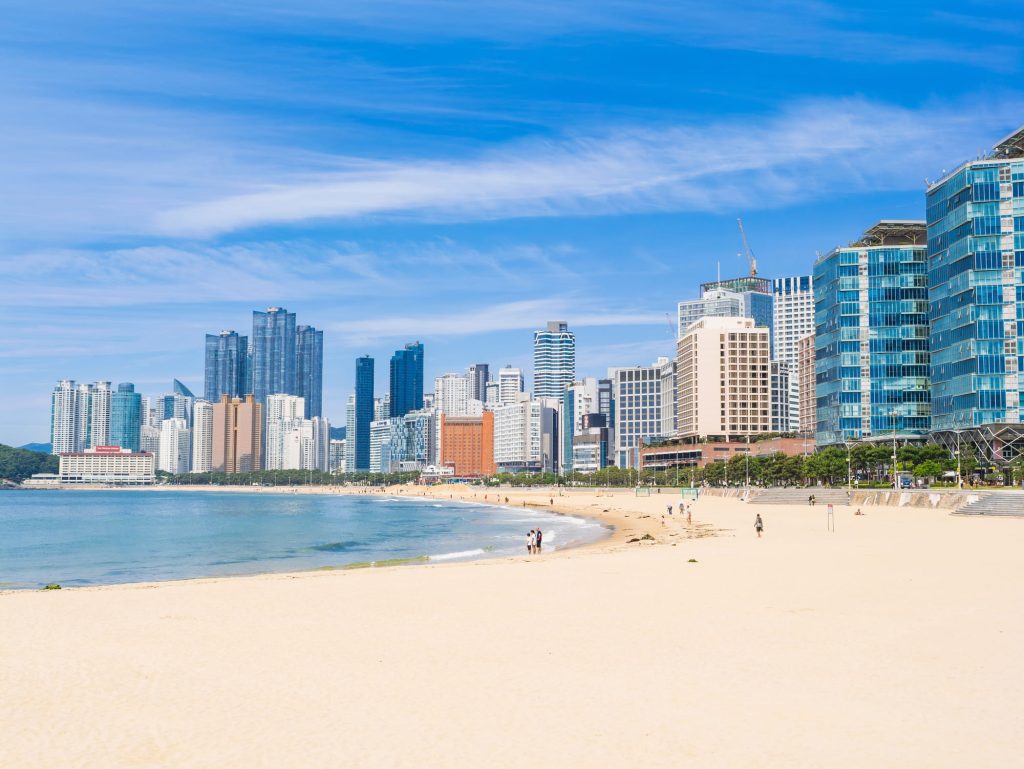
Haeundae is what most people picture when they picture Busan, and for good reason. Its beach is one of the great urban beaches in Asia — wide, long, backed by a wall of high-rise hotels and apartment towers, and genuinely swimmable through summer. It’s also, unavoidably, the most crowded and commercialized part of the city during peak season. In July and August, Haeundae draws roughly a million visitors a month, the sand disappears under a dense grid of rented umbrellas, and restaurant prices creep up to match the tourist volume.
What changes the calculation entirely is timing. In shoulder season — May, June, September, October — Haeundae becomes a different neighbourhood altogether. The beach empties out, prices drop, and the scale of the place shifts from overwhelming to genuinely pleasant. The area has the widest range of hotels in the city, from budget business hotels a few blocks back from the water to five-star properties like the Signiel or Grand Josun sitting directly on the seafront, plus easy access to Shinsegae Centum City, one of the largest department stores in the world, and the Busan Aquarium.
Best for: first-time visitors who want beach access without compromising on hotel quality or dining options, and anyone visiting outside peak summer months. Families tend to gravitate here too, given the density of kid-friendly restaurants and the aquarium.
Trade-offs: summer crowds and prices, and it sits a genuine subway ride or taxi fare from the older, more historic parts of the city like Nampo-dong.
Seomyeon: Busan’s actual center of gravity
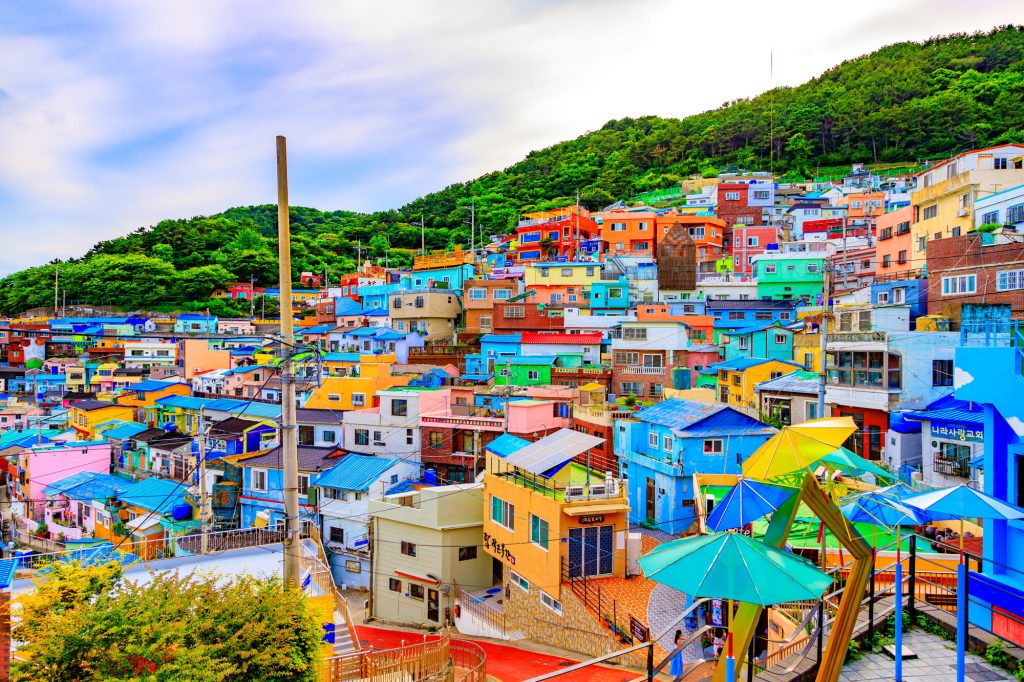
If you only book one place in Busan and want it to just work without much thought, Seomyeon is the safe answer. It’s Busan’s commercial heart, where subway Lines 1 and 2 cross, putting almost everything else in the city within a 15–20 minute ride: Haeundae in about 20 minutes, Nampo-dong in 15, Busan Station and the KTX platform in around 10.
There’s no beach here, and that’s sort of the point. What Seomyeon has instead is density — department stores, an extensive underground shopping mall, a genuinely excellent underground street food market, and a late-night restaurant and bar scene that runs later than most of the coastal neighbourhoods. It’s less scenic than Haeundae or Gwangalli, more of a real working city center, but that’s an asset for travelers who plan to move around a lot and don’t want every evening centered on a beach view.
Korean business hotels cluster here in large numbers, and they’re consistently well-maintained — don’t be put off by the “business hotel” label, since you’ll often get more space and a cleaner room than a similarly priced “boutique” option elsewhere in the city.
Best for: travelers prioritizing transport convenience and value, first-timers who want a central base for day-tripping across the whole city, and anyone arriving by KTX who wants to minimize the transfer to their hotel.
Trade-offs: no beach, and less immediately picturesque than the coastal areas — this is a neighbourhood you use as a base rather than a destination in itself.
Nampo-dong: old Busan, markets, and film history
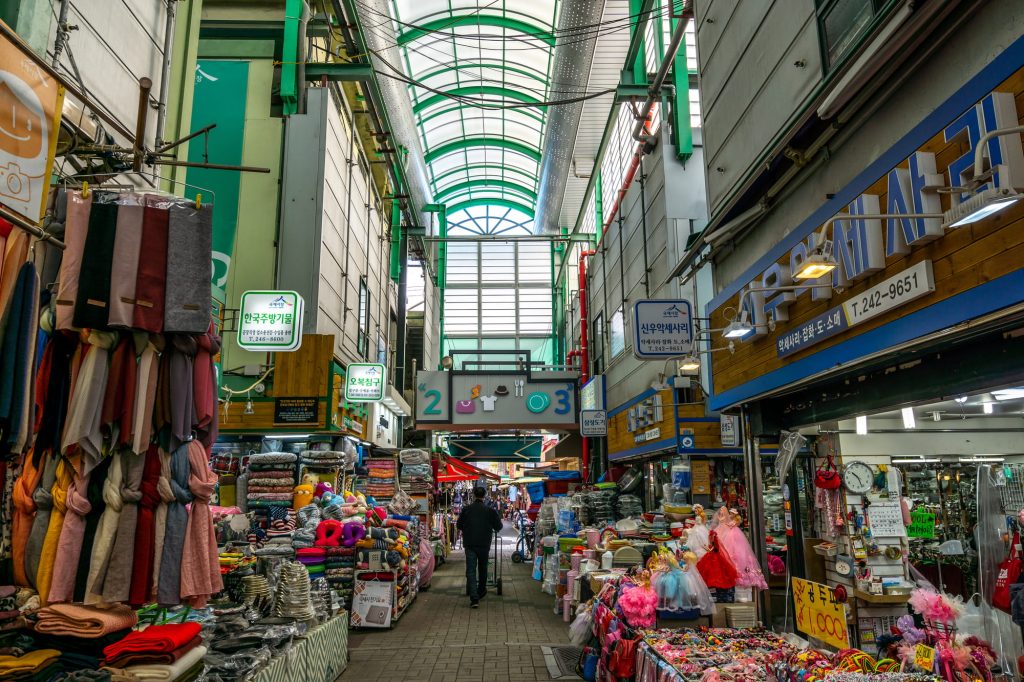
Nampo, along with the adjacent BIFF Square, is central Busan’s historic core and one of the most popular bases for visitors who prioritize food and atmosphere over beach access. It’s home to Jagalchi Fish Market, Korea’s largest seafood market, where you can pick a live catch and have it prepared at an adjoining restaurant within minutes, and to BIFF Square itself, the original home of the Busan International Film Festival, still marked with the handprints of actors and directors who’ve attended over the years.
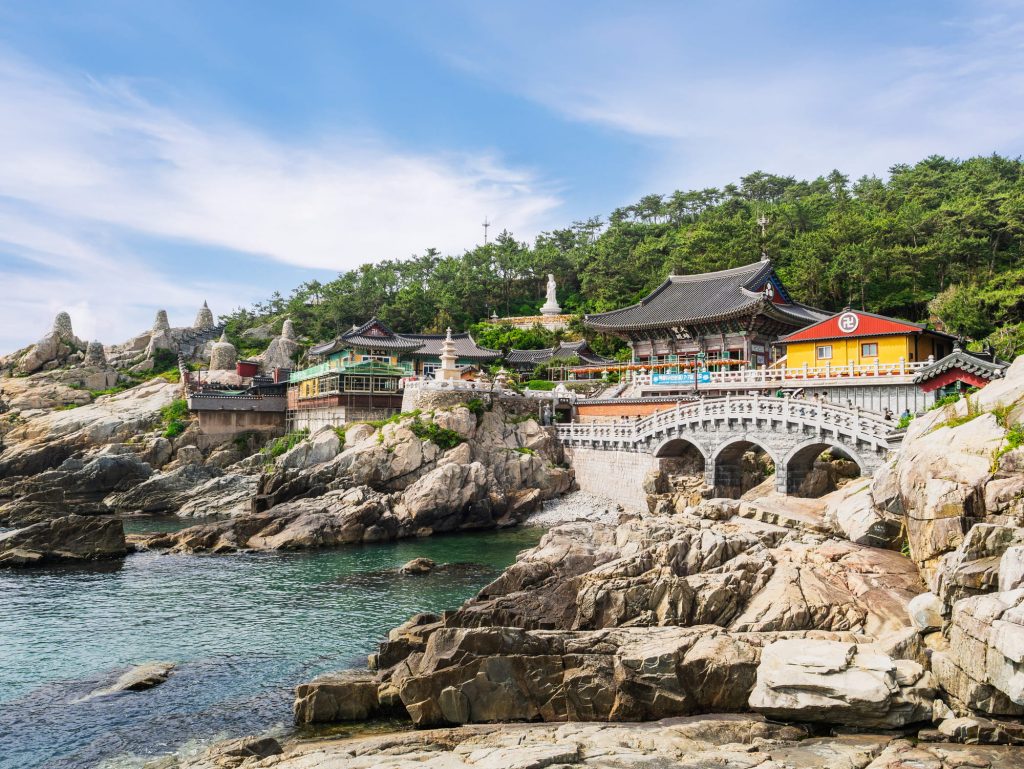
The neighbourhood is dense with affordable accommodation, street food stalls, bars, and shopping, and it’s within easy walking distance of the port. It also functions as a strong base for reaching some of Busan’s more distinctive attractions by bus: Songdo Beach, the Busan Air Cruise cable car, the Songdo Cloud Trails coastal boardwalk, Huinnyeoul Culture Village, Gamcheon Culture Village — the famous multicolored hillside village — and Taejongdae Resort Park at the southern tip of Yeongdo.
Best for: food-focused travelers, budget-conscious visitors who still want a central, walkable neighbourhood, and anyone planning to spend a day exploring Gamcheon Culture Village or Taejongdae, both more conveniently reached from here than from Haeundae.
Trade-offs: no beach directly in the neighbourhood, and it can feel more worn and less polished than Seomyeon or Haeundae, which is either a charm or a drawback depending on what you’re after.
Gwangalli: the local’s beach
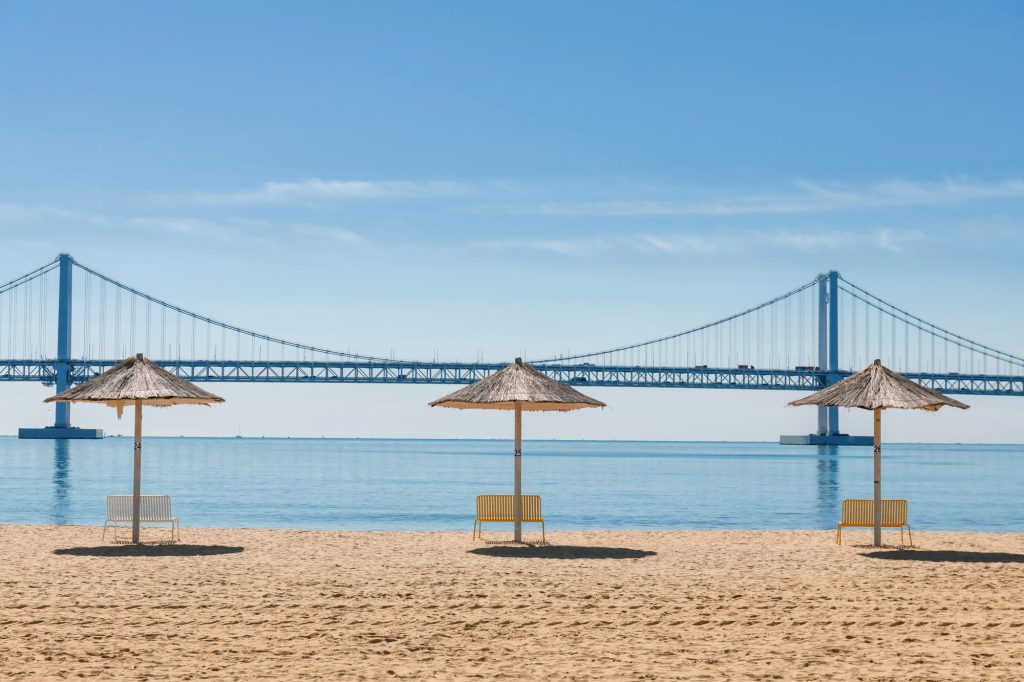
Gwangalli Beach sits a short distance from Haeundae but has a noticeably different character — smaller, calmer, and considerably more residential, with a skyline dominated by the dramatic Gwangan Bridge lit up at night rather than by hotel towers. Where Haeundae leans into a livelier, more overtly touristy atmosphere, Gwangalli’s stretch of cafés and restaurants along the promenade has a more relaxed, trendy, local-feeling pace, closer to what a Busan resident’s actual weekend at the beach looks like.
Hotel inventory here is thinner than in Haeundae, so book earlier if you’re set on this area during peak months, but what’s available tends to be smaller boutique properties and guesthouses rather than large chain hotels.
Best for: travelers who want beach access with a quieter, more residential feel, good food and coffee, and don’t need to be within stumbling distance of nightlife or a department store.
Trade-offs: fewer hotel options than Haeundae, and slightly less directly connected by subway — the closest stations require a bit more walking to reach the beachfront itself.
Centum City: shopping and convenience, minus the character
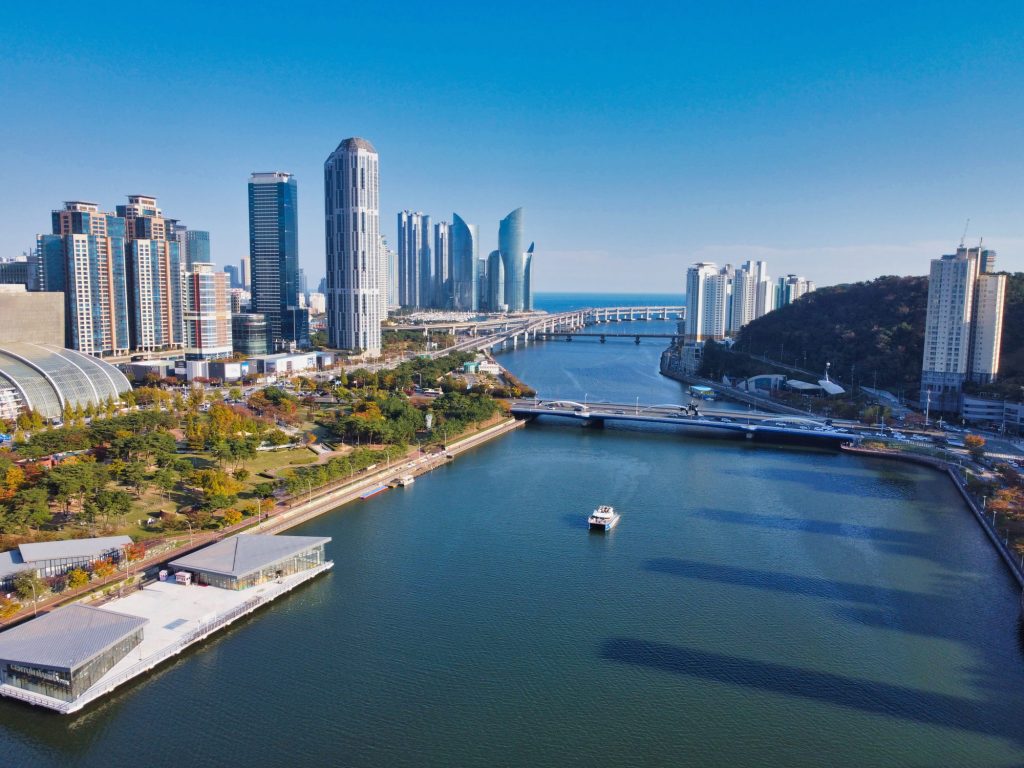
Adjacent to Haeundae but distinct enough to mention separately, Centum City is built around Shinsegae Centum City — the enormous department store and entertainment complex that includes an ice rink, a spa, and a cinema — along with a cluster of large modern hotels aimed at business travelers and shopping-focused visitors. It’s convenient, well-connected by subway, and functional, but it doesn’t have much of the scenic or cultural character that draws people to Busan in the first place.
Best for: shopping-focused trips, business travel, or as a practical fallback if Haeundae proper is fully booked during peak season, since it’s only a short subway ride or walk away.
Yeongdo: a quiet, artsy escape
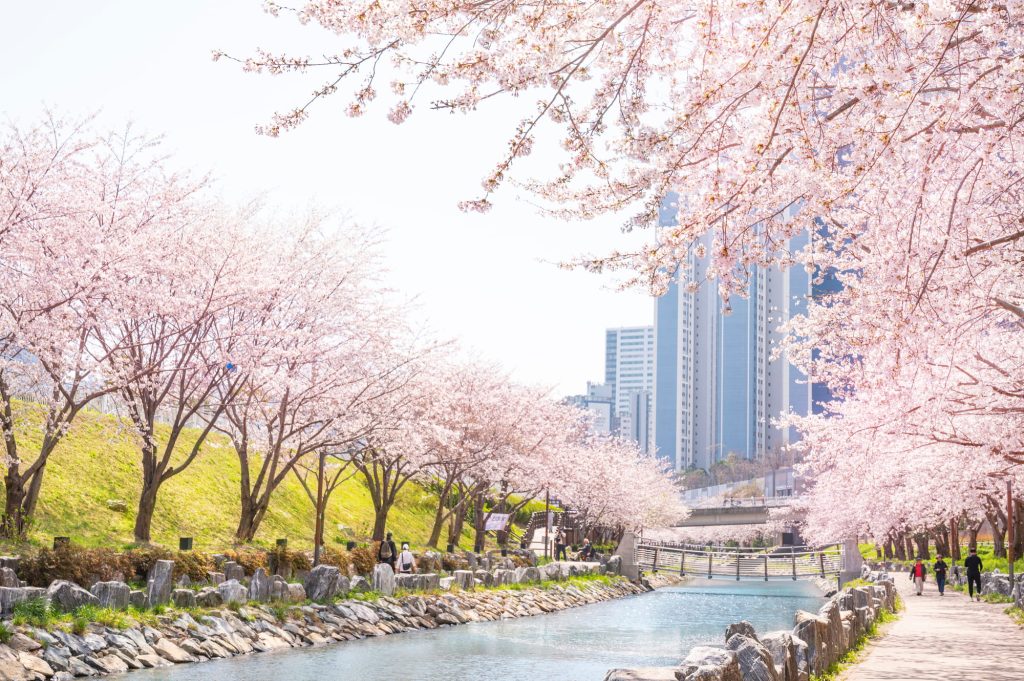
Yeongdo is technically an island, connected to the rest of Busan by a handful of bridges, and it has developed in recent years into one of the city’s more interesting under-the-radar bases. It offers waterside cafés with genuinely good coffee, cultural spaces like the MUSEUM ARTE, the National Maritime Museum, and pockets of quiet coastline and small parks that feel a world away from Haeundae’s density despite being just across the water from Nampo-dong and BIFF Square.
Best for: travelers who’ve already done a Busan trip or two and want something quieter and more residential, or anyone who prioritizes cafés and a slower pace over proximity to major attractions.
Trade-offs: less hotel inventory, and it requires more deliberate planning to reach some of the city’s major sights, though its closeness to Nampo-dong softens this considerably.
Seo-gu and family-friendly options
For travelers with kids specifically, Seo-gu is worth a look — it’s less commonly recommended in general “where to stay” advice but offers a good mix of practical accommodation and family-oriented amenities, and works well as a first-time base if a slower, less overwhelming pace matters more than being in the most photogenic part of the city.
What accommodation costs, by neighbourhood
Prices vary by season more than almost anything else in Busan — summer beachfront rates in Haeundae can run double what the same room costs in November — but as a rough baseline for a standard double room:
| Neighbourhood | Budget | Mid-range | Higher-end |
|---|---|---|---|
| Haeundae | ₩70,000–₩100,000 | ₩150,000–₩280,000 | ₩350,000+ |
| Seomyeon | ₩55,000–₩85,000 | ₩110,000–₩180,000 | ₩220,000+ |
| Nampo-dong | ₩50,000–₩80,000 | ₩100,000–₩160,000 | ₩200,000+ |
| Gwangalli | ₩65,000–₩95,000 | ₩130,000–₩220,000 | ₩280,000+ |
| Yeongdo | ₩50,000–₩80,000 | ₩100,000–₩170,000 | Limited options |
Seomyeon and Nampo-dong consistently offer the best value for a given quality of room, largely because they compete on convenience and food rather than sea views. Haeundae’s premium reflects both its beachfront position and its concentration of five-star international brands, which simply don’t exist in the same numbers elsewhere in the city.
Mistakes people make when choosing where to stay
Assuming Busan is walkable the way Seoul’s central districts are. It isn’t, mostly because of the hills and the sheer distance between coastal points. A hotel that looks close to an attraction on a flat map can still mean a 25-minute uphill walk in practice — check terrain, not just distance, especially around Gamcheon Culture Village and parts of Yeongdo.
Booking Haeundae in July or August without checking prices first. Peak summer rates catch a lot of travelers off guard, sometimes 80–100% above shoulder-season pricing for the same room. If your dates are flexible, shifting even a week or two outside the absolute peak of summer meaningfully changes the budget.
Picking a hotel based only on proximity to Busan Station. Busan Station itself sits in a fairly industrial, low-amenity pocket of the city — convenient for arriving and departing by KTX, but not somewhere you’d want to spend an evening. Seomyeon, one stop away by subway, offers a far better base while remaining just as close to the station in practical terms.
Underestimating how spread out the “must-see” list is. Gamcheon Culture Village, Taejongdae, Haeundae Beach, and Jagalchi Market are all genuinely worth visiting, but they sit in four different corners of the city. Trying to see all of them from a single fixed base without factoring in transit time is the most common planning mistake first-time visitors make.
How to choose based on what you actually want to do
If your Busan trip is mostly about the beach: Haeundae for the full resort experience and range of hotels, or Gwangalli if you’d rather have a quieter, more local scene with excellent cafés.
If you’re combining Busan with a KTX day trip or arriving by train: Seomyeon, given its direct subway connection to Busan Station and central position relative to everything else.
If food and markets are the priority: Nampo-dong, for direct access to Jagalchi Market and the surrounding street food scene.
If you’re short on time and want to see the postcard sights — Gamcheon Culture Village, Taejongdae, the cable car — efficiently: Nampo-dong or Yeongdo, both closer to these southern and western attractions than the Haeundae side of the city.
If nightlife and late-night food matter: Seomyeon, which runs later and livelier than the coastal neighbourhoods.
Getting around once you’ve picked a base
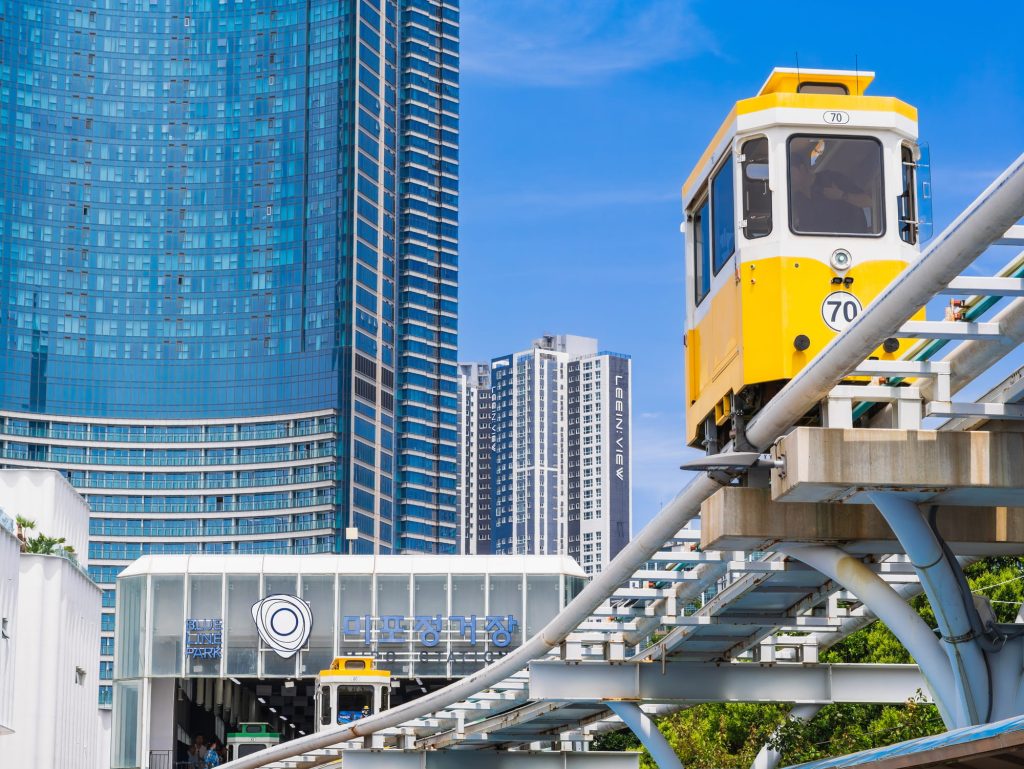
Busan’s subway system, while smaller than Seoul’s, covers the main tourist areas adequately across its main lines, and a T-money card works exactly the same way here as it does in Seoul — buy one at any convenience store, load it up, and it covers subway, bus, and most taxi fares across the city. Given how spread out Busan is and how hilly parts of it are, particularly around Gamcheon and some coastal areas, expect to combine subway rides with buses or the occasional taxi more often than you would in a flatter, more compact city. Elderly travelers or anyone with mobility concerns should factor the hills into their choice of base — Seomyeon and Nampo-dong are comparatively flat and walkable, while some of Haeundae’s back streets and much of Gamcheon involve genuine climbing.
If you haven’t settled on Busan over other second-city options yet, or you’re still deciding how to split time between Busan and the capital, our Seoul vs Busan comparison and guide to getting from Seoul to Busan cover that decision in more depth, and pair naturally with this one once you’ve decided Busan is on the itinerary.
Sample pairings for different trip lengths
A 2-day Busan add-on to a Seoul trip: stay in Seomyeon or Haeundae, and don’t try to cover the whole city — pick either the beach side (Haeundae, Gwangalli) or the old-town side (Nampo, Gamcheon) as your focus, and treat the other as a half-day excursion rather than trying to properly experience both.
A 3–4 day dedicated Busan trip: split your stay, if you don’t mind changing hotels — two nights in Seomyeon or Nampo-dong for the central sights and markets, then two nights in Haeundae or Gwangalli to close the trip with beach time. This avoids the daily cross-city commute a single fixed base can create if your interests span both ends of the city.
A beach-only, low-key trip: stay put in Haeundae or Gwangalli for the full stay and treat everything else as optional day trips, accepting the longer subway ride to reach Nampo-dong or Gamcheon on the days you want to.
Frequently asked questions
Is Haeundae or Seomyeon better for a first-time visitor? Both work well, and the honest answer depends on whether beach access or central transport convenience matters more to you. Haeundae gives you the classic Busan postcard experience with the widest hotel selection; Seomyeon gives you the most efficient base for covering the rest of the city. Many first-timers who want a bit of both end up splitting a longer trip between the two.
How far is Haeundae from Nampo-dong? Around 30–40 minutes by subway, depending on transfers, or a similar duration by taxi outside of heavy traffic. It’s a manageable day-trip distance in either direction, but not something you want to do multiple times a day.
Is Busan safe at night, regardless of neighbourhood? Yes, broadly — Busan, like the rest of South Korea, has a low violent crime rate, and all of the neighbourhoods covered here are safe to walk through at night. Seomyeon and the areas immediately around Haeundae Beach stay busiest and best-lit late into the evening; some of Yeongdo’s quieter residential streets are less populated after dark, which isn’t a safety concern so much as simply quieter.
Do I need a car to get around Busan? No. The combination of subway, buses, and taxis covers the city well, and a car adds parking headaches in a hilly, dense urban environment without much upside for a typical multi-day visit. It’s really only worth considering if you’re planning extensive side trips well outside the city itself.
Which neighbourhood has the best food scene? Nampo-dong and Seomyeon both have strong claims — Nampo for fresh seafood and Jagalchi Market, Seomyeon for its underground street food market and late-night restaurant density. Gwangalli and Haeundae both have excellent café and casual dining scenes as well, skewing more toward brunch spots and Western-style cafés than traditional Korean dining.
What’s the best neighbourhood for solo travelers? Seomyeon tends to suit solo travelers particularly well — it has the widest range of budget-friendly business hotels and guesthouses, the most going on in the evening within walking distance, and the easiest transport connections if you’re moving around alone and want to minimize planning around bus and subway schedules.
Busan rewards a little upfront planning more than most Korean cities do, mostly because it genuinely is several distinct experiences stitched together along one long coastline. Picking a neighbourhood that matches what you actually want from the trip — rather than the one with the prettiest photos — makes the difference between a Busan visit that feels effortless and one spent shuttling back and forth across the city more than you’d planned.