
Seoul to Busan is the most-travelled intercity route in South Korea, and the decision between KTX, bus, and plane is not as obvious as it first appears. The distance is 325 kilometres, the travel time ranges from 2.5 hours to 5 hours depending on what you choose, and the price difference between the cheapest and most expensive option on the same day can be ₩50,000 or more.
This guide compares every realistic option with honest door-to-door times, current prices, and a clear recommendation for each type of traveller.
Exchange rates June 2026: ₩1,500 = $1 USD / ₩1,680 = €1 EUR
Quick Answer
| Option | Door-to-door time | Cost (one way) | Best for |
|---|---|---|---|
| KTX (SRT) express | 2.5–2.75 hours | ₩59,800–₩73,000 (~$40–$49 / €36–€43) | Most travellers |
| KTX standard | 3–3.5 hours | ₩59,800 (~$40 / €36) | Rail pass holders |
| Express bus | 4–4.5 hours | ₩23,000–₩34,000 (~$15–$23 / €13–€20) | Budget travellers |
| Flight (Gimpo to Gimhae) | 3.5–4 hours door-to-door | ₩40,000–₩90,000 (~$27–$60 / €24–€54) | Only if fares are very low |
| Overnight bus | 5–6 hours | ₩20,000–₩28,000 (~$13–$19 / €12–€17) | Budget + saves a hotel night |
The short version: Take the KTX. For almost every traveller, the train is the right answer: faster than the bus, cheaper than flying when you include airport transfers, and it delivers you to Busan Station in the city centre with no further transfer needed.
Option 1: KTX (Korea Train Express)
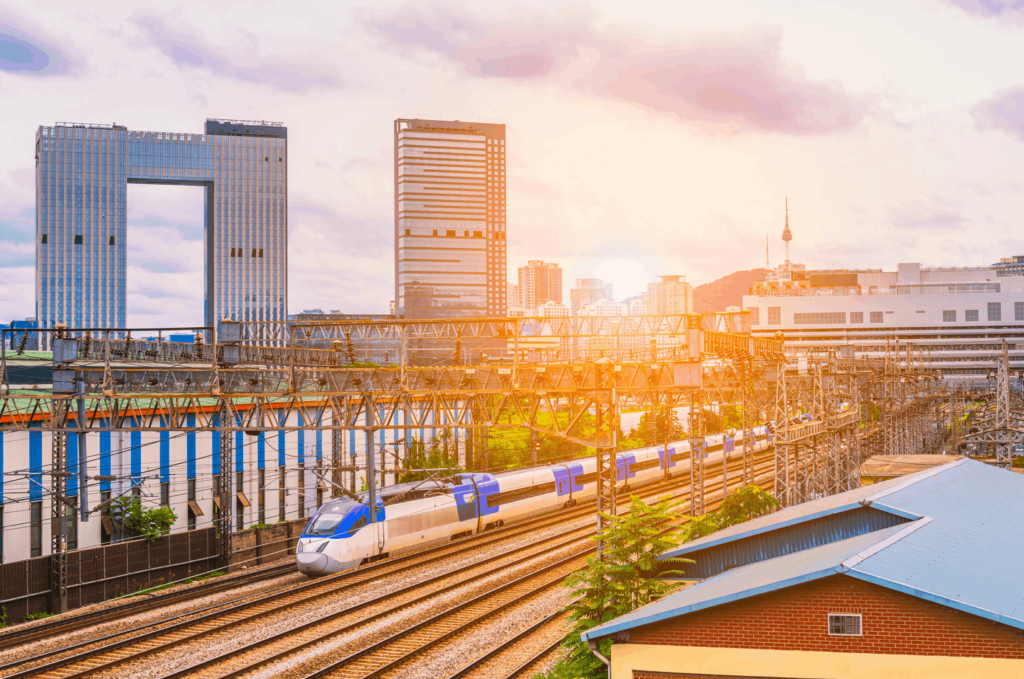
The KTX high-speed train is the standard way to travel between Seoul and Busan and has been since the line opened in 2004. Two generations of trains now run the route: the original KTX-1 and the newer KTX-II (Sancheon): along with SRT trains operated by SR (a separate rail company that shares the same high-speed tracks).
Journey time
The fastest KTX services: the express trains that stop only at Daejeon and Dongdaegu: cover Seoul Station to Busan Station in approximately 2 hours 25 minutes to 2 hours 40 minutes. Standard KTX services that stop at more stations take 2 hours 50 minutes to 3 hours 10 minutes.
SRT trains depart from Suseo Station (Gangnam, subway Line 3 Yangjae, or Line 8 Suseo) rather than Seoul Station and reach Busan in around 2 hours 15 minutes on the fastest services. If you are staying in Gangnam, the SRT from Suseo avoids the trip across the river to Seoul Station.
Price
Standard KTX adult fare (Seoul to Busan): ₩59,800 (~$40 / €36) for a standard seat in a regular car. First-class (KTX Special Car) runs approximately ₩83,700 (~$56 / €50).
SRT fares are slightly cheaper: standard seat from approximately ₩52,600 (~$35 / €31).
Discounts available: early booking (up to 30% off up to 60 days ahead), youth discounts (ages 13–24), senior discounts (65+). Book on the Korail website (letskorail.com) or the SRT app.
Stations
From Seoul: Seoul Station (most KTX), Yongsan Station (some services), Suseo Station (all SRT)
To Busan: Busan Station (city centre) for KTX. Busan Station is in the middle of the city: from there, subway Line 1 connects to Seomyeon, Nampodong, and the rest of the city centre. No additional transit needed.
Author’s Tip: Book at least a week in advance for weekend travel and 2–3 weeks ahead for public holiday periods (Chuseok, Lunar New Year, and long weekends in May). The KTX fills up fast and late-bookers often find only standing tickets or fully sold-out trains. The Korail app has an English-language booking interface and accepts international cards.
Option 2: Express Bus
The express bus from Seoul to Busan is slower than the KTX but costs significantly less. It is the practical choice for travellers on a tight budget who are not in a hurry.
Journey time
4 to 4.5 hours under normal conditions. During heavy traffic: Friday evenings, public holiday weekends, August: this extends to 5–6 hours. The motorway between Seoul and Busan is one of the busiest in the country and traffic is unpredictable.
Price
₩23,000–₩34,000 (~$15–$23 / €13–€20) depending on operator, bus class, and booking timing. Premium buses (wider seats, more legroom, fewer rows) run at the higher end. Standard express buses sit at the lower end.
Stations
From Seoul: Seoul Express Bus Terminal (Gangnam, subway Lines 3, 7, and 9) or Seoul Central City Terminal (same building, different operator). Some services depart from Dong Seoul Bus Terminal (Gangbyeon Station, Line 2).
To Busan: Busan Central Bus Terminal (Nopo-dong, northeast of the city) or Busan Seobu Bus Terminal (Sasang, west of the city). Neither is in the central area: from Nopo-dong, you need subway Line 1 to reach Seomyeon or Nampodong (20–30 minutes). Factor this transfer into the real journey time.

Option 3: Flight (Gimpo to Gimhae)
The flight from Seoul Gimpo Airport (GMP) to Busan Gimhae Airport (PUS) takes 55–60 minutes in the air. Door-to-door, however, the numbers rarely work out in the plane’s favour.
Door-to-door reality
From central Seoul to Gimpo Airport: 30–40 minutes by subway (AREX All-Stop or subway Line 5/9). Check-in and security: domestic flights recommend 60 minutes minimum. Flight: 55–60 minutes. From Gimhae Airport to central Busan: bus approximately 40–50 minutes; subway 30–40 minutes.
Total door-to-door: 3.5 to 4.5 hours, which is slower than the KTX on most comparisons.
When flying makes sense
The flight wins only when fares are very low: below ₩40,000 (~$27 / €24) one-way: and you are already close to Gimpo Airport. Budget carriers Jeju Air, Jin Air, and T’way Air occasionally offer flash sales on this route. If you catch one at ₩25,000–₩35,000, the total cost may undercut the KTX by a meaningful amount. But the time cost remains higher.
Airlines: Korean Air and Asiana (full-service), Jeju Air, Jin Air, Air Busan, T’way Air (budget).
Option 4: Overnight Bus
Several operators run overnight express buses from Seoul to Busan that depart late evening (typically 22:00–24:00) and arrive early morning (05:00–07:00). The seats are wider and more reclined than standard express buses: semi-private pods on some services.
When it makes sense
If you can sleep on a moving vehicle and want to save the cost of a hotel night while covering the distance, the overnight bus is genuinely useful. You board in Seoul, sleep for most of the journey, and arrive in Busan ready for a full day. The ₩20,000–₩28,000 (~$13–$19 / €12–€17) fare compares favourably to the combined cost of a KTX ticket and a hotel night, even a budget one.
Departure: Seoul Express Bus Terminal or Seoul Central City Terminal, late evening. Arrival: Busan Central Bus Terminal, early morning.
Using the KTX with a Rail Pass
The KR Pass (Korea Rail Pass) covers KTX travel between Seoul and Busan, but with a significant caveat: the KR Pass excludes the SRT (SR trains operated by a separate company) and some specific express services. Pass holders ride standard KTX services, which take 2 hours 50 minutes to 3 hours rather than the 2 hours 25 minutes of the fastest trains.
For a dedicated Seoul-Busan trip, the KR Pass is rarely worth buying: point-to-point KTX tickets at ₩59,800 each way are often cheaper than the pass unless you are making multiple long-distance train journeys across the country within a short window. The pass makes more sense for trips that also include Gyeongju, Jeonju, Daegu, and Gyeongsan in the same journey.
KTX vs Bus: The Real Comparison
The 2-hour time saving on the KTX compared to the express bus costs approximately ₩37,000 (~$25 / €22) extra one-way. Whether that is worth it depends entirely on what you are doing with those two hours. For most leisure travellers, arriving in Busan at noon rather than 14:00 buys an afternoon at Haedong Yonggungsa Temple or Gamcheon Culture Village.
For trips where time genuinely does not matter: a night arrival, an open schedule, a very tight budget: the bus is a perfectly reasonable choice. The seats are more comfortable than they used to be and the motorway is well-maintained.
Practical Notes
Booking KTX: Korail website (letskorail.com) accepts international Visa and Mastercard. The app has English-language booking. You can collect tickets from station machines using your booking number, or use a mobile ticket on the app.
Luggage: KTX trains have overhead racks and a luggage area at the end of each car. There are no size restrictions for carry-on luggage, but large bags should go in the end-of-car racks rather than the overhead. There are no luggage storage services on the train itself.
Seat selection: On the KTX, window seats on the right side (facing Busan) give views of the countryside; on the return, the same seats face the mountains north of Seoul. For a daytime journey in autumn (September–November), the scenery through the central mountain section is genuinely good.
Food: KTX trains have a restaurant car serving light meals and snacks. Better to buy from the station convenience stores before boarding. Seoul Station has GS25, Paris Baguette, and several food court options.
FAQ
How long is Seoul to Busan by KTX? The fastest trains take 2 hours 25 minutes (Seoul Station to Busan Station). Standard KTX services take approximately 2 hours 50 minutes to 3 hours 10 minutes.
Is the KTX from Seoul to Busan expensive? At ₩59,800 (~$40 / €36) for a standard seat, it is reasonable by international high-speed rail standards. Early booking discounts can reduce this by up to 30%.
Is it better to fly or take the train from Seoul to Busan? For most travellers, the train is better. Door-to-door times are comparable or faster, Busan Station is more centrally located than Gimhae Airport, and the price difference is small once you factor in airport transfer costs.
Can I take a bus from Seoul to Busan? Yes. Express buses depart from Seoul Express Bus Terminal and take 4–4.5 hours. Fares from ₩23,000 (~$15 / €13). The bus terminal arrival in Busan is less central than Busan Station.
Do I need to book in advance? For weekends and public holidays, yes. Book at least 1–2 weeks ahead. Weekday travel has more availability but early booking discounts still apply.
Prices and timetables verified June 2026. Always check current fares on letskorail.com or the SRT app before booking. Exchange rates: ₩1,500 = $1 USD / ₩1,680 = €1 EUR.
👉 Busan Travel Guide: Complete Korea Trip Planner