
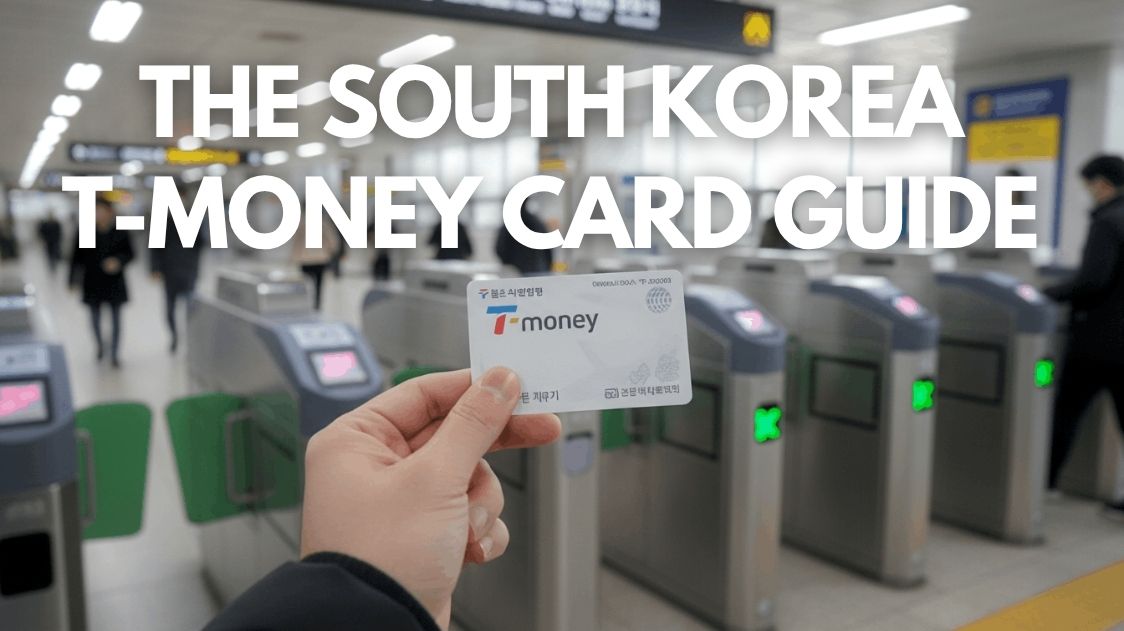
The first thing you notice stepping out of the arrivals hall at Incheon is that everything moves fast. The AREX train to the city pulls in every few minutes, buses hiss out of the terminal bays in an orderly rotation, and taxis queue in lanes that actually function. What brings all of it to a halt, for the visitor who didn’t plan ahead, is the moment they realise they have no way to pay.
Seoul’s transit system runs almost entirely on contactless smart cards. Buses in many parts of the city no longer accept cash at all. Standing at a ticket machine trying to buy a single-use paper card every time you want to board adds up — the inconvenience, the time, and the fact that you lose all the transfer discounts that make the system genuinely cheap. Getting a card sorted before you leave the airport is one of those small logistics decisions that quietly makes an entire trip easier.
The T-money card has been the standard for well over a decade, and in most cases it’s still the right starting point. But the ecosystem around it has shifted meaningfully in 2026. There are short-term unlimited passes that make more sense for many visitors than the old monthly option. New kiosks at major stations now accept international credit cards. And if you have an iPhone with a Mastercard, there’s a new mobile option worth knowing about — with some caveats. This guide lays out what’s actually available, what it costs, and how to use it without the usual confusion.
Why Seoul’s Transit System Requires a Card
Seoul operates 22 subway lines and hundreds of bus routes that function as one integrated network. Every tap in and out feeds into a unified distance-based calculation — the system tracks how far you’ve traveled across different vehicles and applies discounts automatically when you transfer. That calculation only works with a smart card. Cash passengers on buses get charged a flat fare with no transfer benefit, and single-journey subway tickets leave you paying full price on every leg. Over a week of sightseeing, that difference is real money.
The standard adult base fare is ₩1,550 (≈$1.05 / €0.90) with a T-money card, versus ₩1,650 (≈$1.10 / €0.95) for a single-ride paper ticket. The subway runs from around 05:30 to midnight. After that, night buses marked with an N prefix cover major routes until around 06:00 AM at a flat ₩2,500 (≈$1.65 / €1.45) fare. There’s essentially no scenario where you need anything other than a card to move around the city.
One more thing: Seoul’s buses have gone largely cashless. Many routes no longer accept cash at all. Sorting out a card on day one isn’t a nice-to-have — it’s genuinely necessary.
The Cards
Standard T-money Card
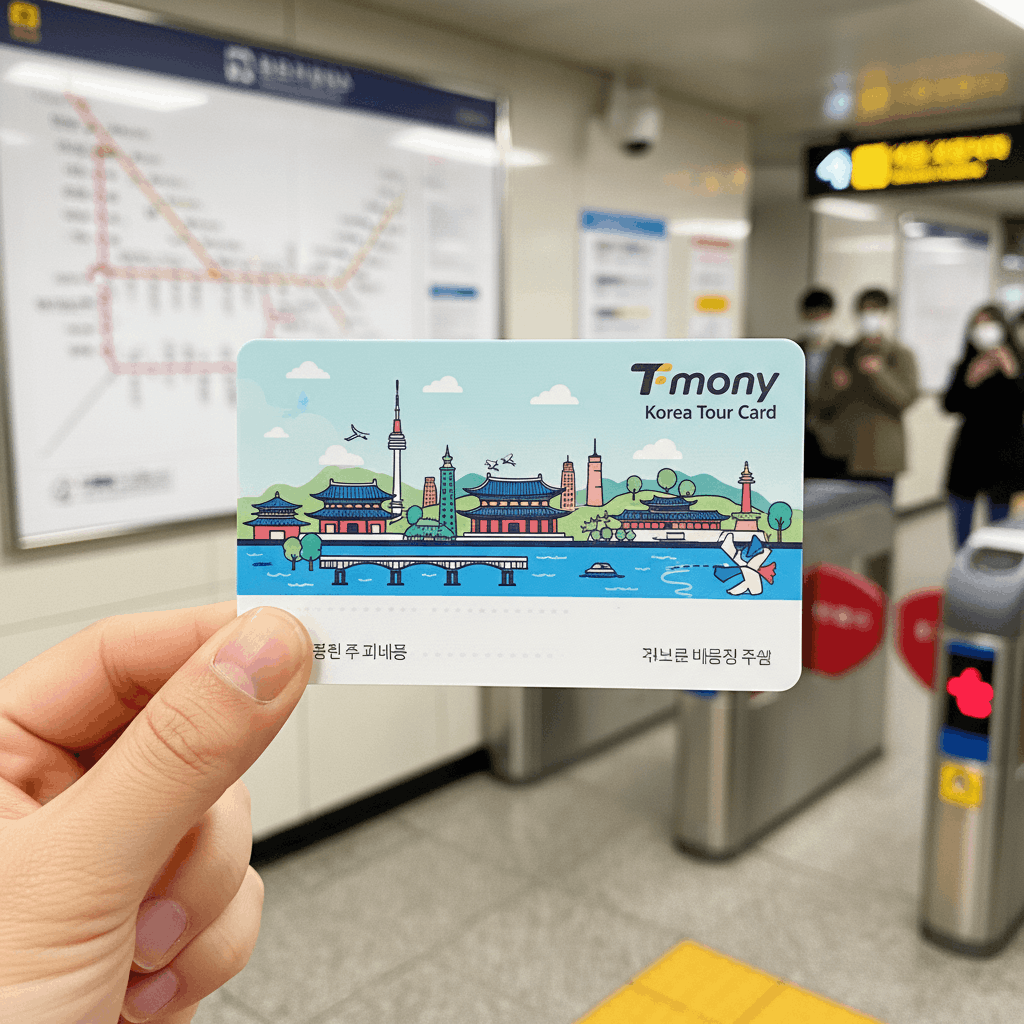
The default option, and for many travelers all they need. The card costs between ₩2,500 and ₩4,000 (≈$1.65–$2.65 / €1.45–€2.30) depending on design — plain cards at the lower end, character versions (Kakao Friends, Line Friends) a bit more. You’ll also find limited-edition designs at vendors in Myeongdong and the Hongdae underground shopping centers, though those are more souvenir than transit tool. Load it with cash or, at major stations now, with an international credit card, and it works across subways, buses, most taxis, and convenience stores nationwide.
Coverage is genuinely national. The same card works in Busan, Daegu, Gwangju, and most of Jeju, you don’t need a separate card for each city. The balance is valid for five years from the last transaction, so many regular visitors keep the same card across trips and reload it on arrival. The physical card itself is non-refundable; the balance on it is a different matter, covered in the refund section below.
Best for: Multi-city itineraries, flexible travel plans, first-time visitors who want one reliable option.
Climate Card: Short-Term Tourist Passes
This is where the 2026 update matters most. The Climate Card started as a monthly unlimited pass for Seoul commuters. Since mid-2024, it also comes in short-term tourist versions that most day-counting visitors should be looking at instead:
| Duration | Price | Approx. USD | Approx. EUR |
|---|---|---|---|
| 1 day | ₩5,000 | ~$3.35 | ~€2.85 |
| 2 days | ₩8,000 | ~$5.35 | ~€4.55 |
| 3 days | ₩10,000 | ~$6.65 | ~€5.70 |
| 5 days | ₩15,000 | ~$10.00 | ~€8.55 |
| 7 days | ₩20,000 | ~$13.35 | ~€11.45 |
| Monthly (subway + bus) | ₩62,000 | ~$41.35 | ~€35.45 |
| Monthly (+ Ttareungi bikes) | ₩65,000 | ~$43.35 | ~€37.15 |
At ₩1,550 per subway ride, a 5-day pass pays for itself after ten trips. If you’re moving through Seoul at a normal sightseeing pace, ten rides in five days is nothing. The physical card costs an additional ₩3,000 (≈$2.00 / €1.70) separately, you buy the card, then load the pass onto it at a station kiosk or information center. Since March 2026 those kiosks accept international credit cards, so once you’re in the city you don’t need Korean cash to set one up. The pass timer starts from first use, not from purchase, which means you can buy it the evening before a full day without wasting any of it.
Coverage caveats: The Climate Card covers Seoul subway lines, Seoul-licensed buses, and some connected routes into Gyeonggi-do province, but not all of Gyeonggi, and not airport limousine buses or red wide-area express buses. More importantly: you cannot tap into the system at Incheon Airport with a Climate Card. You need a T-money card or single-journey ticket for the airport leg. You can, however, tap out at Incheon Airport T1 and T2 if you’re returning to the airport on the all-stop train.
The practical sequence on arrival: get a T-money card at the arrivals hall convenience store, use it for the AREX into the city, then pick up a Climate Card tourist pass at a major station kiosk once you’re there.
Best for: Travellers spending 3+ days primarily in Seoul with regular transit use.
Discover Seoul Pass
Not primarily a transit card, it’s a tourist attraction pass that happens to include T-money functionality. The pass grants free entry to 70+ Seoul venues and discounts at 150+ others. Pass options include a Pick 3 Basic Pass from ₩49,000 (≈$32.65 / €28.00), a Pick 3 Theme Park Pass at ₩70,000 (≈$46.65 / €40.00, includes one major theme park plus two attractions), a 72-hour pass at ₩90,000 (≈$60.00 / €51.45), and a 120-hour pass at ₩130,000 (≈$86.65 / €74.30).
One detail most guides miss: only the physical card version includes T-money transit functionality. The mobile app version does not work as a transit card. If you want the combined attraction-plus-transit benefit, you need to collect the physical card at a designated counter (usually Myeongdong Tourism Information Center or Seoul Tourism Plaza).
Whether it’s worth it comes down to the math. Add up the individual entry fees to venues you genuinely plan to visit: Gyeongbokgung (₩3,000 / ≈$2.00 / €1.70), N Seoul Tower observation deck (≈₩21,000 / ≈$14.00 / €12.00), Lotte World (≈₩62,000 / ≈$41.35 / €35.45). If your itinerary includes two or three ticketed attractions per day, the pass pays for itself fast. If you’re mostly walking neighbourhoods and eating street food, it won’t. One useful detail: the pass clock starts when you use it at your first free attraction, not at purchase, so there’s no penalty for picking it up the day before you plan to use it.
Best for: Visitors with a packed 2-to-3 day ticketed attraction itinerary, physical card only.
WOWPASS and NAMANE
These two cards solve the same problem, not transit, but everyday spending, and are worth comparing directly.
WOWPASS combines currency exchange, a prepaid debit card accepted at Korean shops, and a T-money transit chip. You exchange foreign currency at kiosks (320+ locations, including Incheon Airport, Gimpo, and major subway stations) and load Korean won instantly. The card costs ₩5,000 (≈$3.35 / €2.85) and accepts 16 currencies.
The detail that catches most people off guard: WOWPASS has two completely separate wallets. The shopping balance — loaded with your exchanged foreign currency, pays for purchases. The T-money transit chip has its own separate balance that starts at zero. Exchange dollars at a kiosk, tap at a subway gate: rejected, because the transit wallet is empty. To load it, you insert Korean won cash at a convenience store or station kiosk. iPhone users can also transfer between wallets via NFC through the WOWPASS app, which removes the cash requirement for transit top-ups on that platform.
NAMANE works similarly but with one meaningful advantage: it lets you top up the T-money transit balance directly through its app using Apple Pay, Google Pay, or a foreign credit card, with a small fee. No cash required for transit. NAMANE also lets you customise the card face with a photo printed at a kiosk, useful if you want a personalised or K-pop-themed card.
On exchange rates: both cards beat the airport counters, which are the most expensive option you’ll encounter. Neither gives you the absolute best rates, those are at the independent money changers in Myeongdong and Namdaemun, where rates are typically 2–4% better than WOWPASS or NAMANE. What you gain with the card options is 24-hour kiosk access and the ability to use the loaded balance as a local debit card everywhere, without foreign transaction fees on each purchase.
One practical note: the WOWPASS kiosk at Incheon Airport is located inside the CU convenience stores at Terminal 1 and T2, it’s available on arrival, but you need to find that specific CU branch.
WOWPASS best for: Travellers who need currency exchange and a local spending card; larger, more established kiosk network.
NAMANE best for: Travellers who want to avoid cash top-ups for transit entirely; also the better pick for K-pop fans who want a personalised card.
Where to Buy
Incheon Airport: GS25 and CU convenience stores in the arrivals area of both terminals sell T-money cards and Climate Card tourist passes. Get one here before heading to the trains: the international-card kiosks are at city stations, not at the airport platform level. Withdraw ₩30,000–₩50,000 (≈$20–$33 / €17–€29) from an airport ATM and load the card with cash at the convenience store.
Convenience stores: Every GS25, CU, 7-Eleven, and Emart24 in Korea sells T-money cards, around the clock. Asking for one at the counter is a 90-second transaction. There’s no reason to buy online before your trip, third-party resellers typically mark up basic ₩3,000 cards by 200–300%.
Subway station kiosks: Since March 17, 2026, Seoul Metro has installed 440 new kiosks across 273 stations on Lines 1–8 that accept Visa, Mastercard, JCB, UnionPay, and Amex. These kiosks sell and reload both T-money cards and Climate Card tourist passes, no Korean cash needed. Major hubs with the new machines include Seoul Station, Myeongdong, Hongik University, Gangnam, Jamsil, and Itaewon. Older machines at smaller and suburban stations remain cash-only.
Reloading Your Card
Cash at station kiosks: Select your language (English, Japanese, or Chinese), place the card on the sensor pad, choose an amount up to ₩90,000 (≈$60.00 / €51.45), and insert bills. Wait for the confirmation screen before removing the card.
Cash at convenience stores: Hand the card and cash to the cashier and say “chung-jeon” (충전, meaning charge). Done in about ten seconds, anywhere in the country.
International cards at new kiosks: The 440 new kiosks on Lines 1–8 accept international cards for reloading both standard T-money cards and Climate Card passes. At a major central station, this option is available. At a smaller suburban stop, assume cash-only.
MobileTmoney via iPhone (Mastercard): Since April 2026, Mastercard holders with an iPhone or Apple Watch can download the MobileTmoney app, register, and load a transit balance using their Mastercard through Apple Wallet. The phone then taps at subway gates like a physical card. The important detail: this works through the MobileTmoney app specifically, you’re not tapping your Mastercard directly at the gate. The app needs to be downloaded, registered, and funded before you reach the turnstile. Visa support has not been confirmed. For anyone outside this setup, a physical card is simpler.
It’s also worth noting that the new international-card kiosks are not yet at Incheon Airport’s platform level, and the open-loop system that would let foreign cards tap directly at gates is still in early rollout stages (the Seoul Metropolitan Government’s roadmap targets 2027–2030 for full implementation). The current situation is genuinely improved compared to 2024, but it’s not yet seamless everywhere. Having a physical T-money card as backup remains good practice even if you plan to use MobileTmoney or the new kiosks.
Practical tip: Load small amounts and reload often, ₩20,000 (≈$13.35 / €11.45) at a time is plenty. Keeping your balance modest also makes the airport departure cleaner, since refunding a large balance requires more steps.
Fares and the Transfer Discount
The base fare on Seoul Metro is ₩1,550 (≈$1.05 / €0.90), following the June 2025 increase. Standard city buses cost ₩1,500 (≈$1.00 / €0.85). A ₩100 surcharge applies for every 5 kilometres above the first 10.
The transfer discount is what makes Seoul transit genuinely economical. Switch to another vehicle within 30 minutes of your last tap-out and the system applies combined distance rates instead of a new base fare. Between 21:00 and 07:00 that window extends to 60 minutes. Up to four transfers per journey qualify. The discount applies across subway-to-bus, bus-to-bus, bus-to-subway, and subway-to-subway transfers.
The one hard rule: tap out every time you exit a vehicle. On buses, the reader is at the rear door. On the subway, at the exit turnstile. The 30-minute clock starts from that tap-out. Forget to tap off a bus and the system charges you the maximum possible distance fare, and your transfer window never opens. This is the single most common mistake tourists make, and it happens because buses are often crowded and the rear-door reader is easy to walk past without thinking.
If you’re riding the subway and transferring to another subway line, you don’t need to exit the station: the system reads the transfer automatically when you tap back in. The 30-minute rule applies to transfers between subway and bus, or between separate bus journeys where you exit a vehicle entirely.
T-money does not work for KTX high-speed rail, long-distance express buses, or international ferries: those require separate bookings.
Bus colors
Seoul buses are color-coded in a genuinely useful way. Blue buses run major arterial routes between districts — the ones you’ll use most. Green buses are shorter neighborhood routes connecting subway stations to residential areas; handy when your hotel or a restaurant you want is a kilometer from the nearest station. Yellow buses loop through the city center. Red buses are express services to satellite cities like Bundang and Ilsan, priced higher (₩3,000+ / ≈$2.00+ / €1.70+) and useful for day trips. Night buses (N prefix) run from around 23:30 to 06:00 at a flat ₩2,500 (≈$1.65 / €1.45), covering the hours after the subway shuts down.
On all regular buses: board at the front, exit at the rear, and tap at both doors. The rear tap is mandatory for the transfer discount.
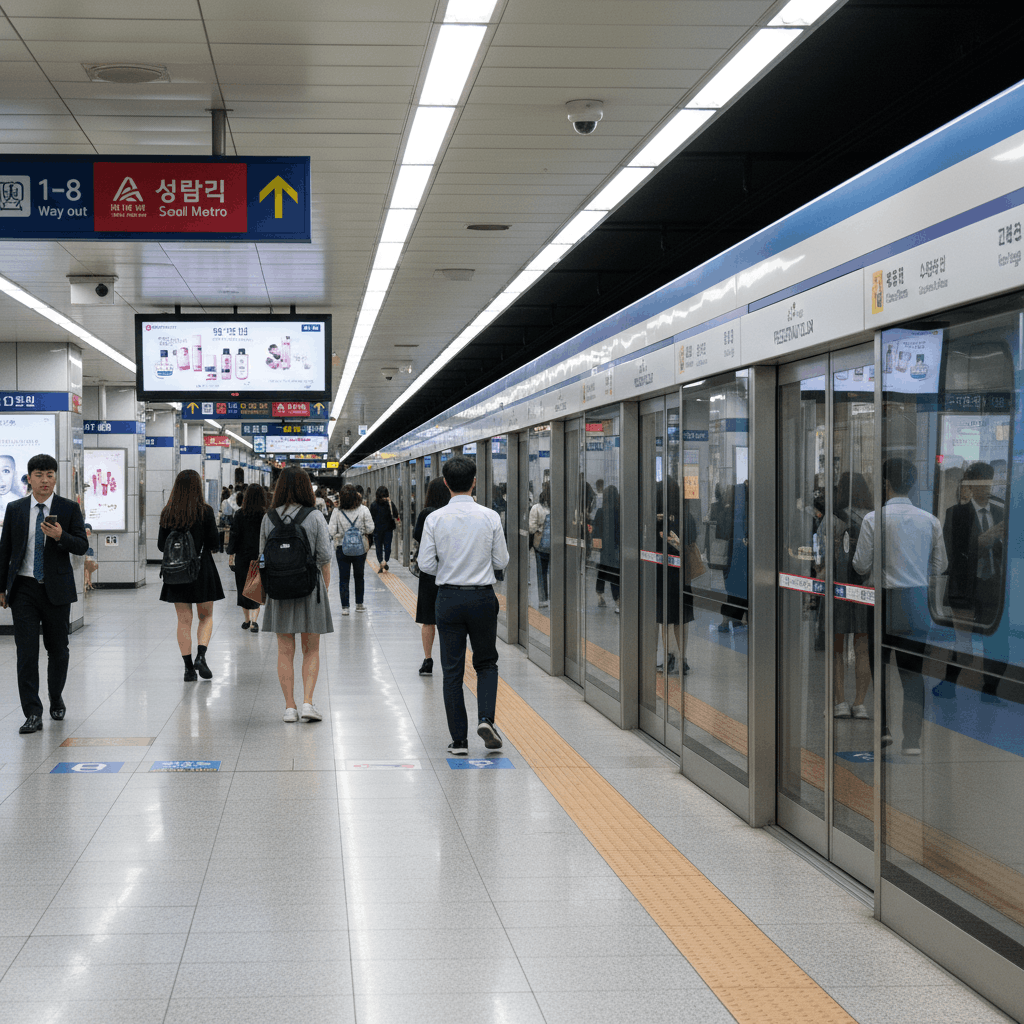
Which Card for Which Trip
Spending most time in Seoul, or splitting between cities? For 3+ days in Seoul with regular transit use, a Climate Card short-term pass is almost always cheaper than paying per ride. For multi-city itineraries — Seoul, then Busan, then somewhere else — T-money’s nationwide coverage is more practical.
Want to avoid cash top-ups entirely? NAMANE lets you load the T-money chip via app with a foreign card. The new station kiosks on Lines 1–8 also accept international cards for T-money reloads. The cash-only era is ending, but it hasn’t ended everywhere.
Need currency exchange and a local spending card? WOWPASS or NAMANE. If your foreign credit card already works smoothly at Korean payment terminals, you probably don’t need either.
Visiting multiple paid attractions in a tight window? Run the numbers on Discover Seoul Pass, physical card only if you want the transit function included.
iPhone with Mastercard? The MobileTmoney integration works. Set up the app before you land and you can skip the physical card entirely.
Refunds Before You Leave
Balance under ₩20,000 (≈$13.35 / €11.45): Any convenience store. Cashier scans the card, returns the cash, deducts ₩500 (≈$0.33 / €0.29). You keep the card. Aim for this outcome.
Balance ₩20,000–₩50,000 (≈$13.35–$33.35 / €11.45–€28.60): Visit a subway station customer service center. Same ₩500 fee, cash on the spot.
Balance over ₩50,000 (≈$33.35 / €28.60): Avoid this. Large refunds require additional administrative steps and, for foreign visitors without a Korean bank account, processing time of several business days. Load small and spend down during your last day.
At the airport: No convenience stores or refund points exist past the security checkpoint at Incheon. Handle any refund before check-in at the arrivals-level GS25 or CU. If you’re airside with leftover balance, spend it at an airport shop before boarding.
What a Week Actually Costs
Over seven days in Seoul in May 2026, moving between Bukchon and Gangnam with a couple of evening taxi rides and a day trip to Suwon, a starting load of ₩30,000 (≈$20.00 / €17.15) on a T-money card came down to ₩2,400 by the end of day seven. That covered 18 subway rides and 6 bus trips with full transfer discounts applied.
For 3–5 days mostly within Seoul: ₩20,000–₩30,000 (≈$13.35–$20.00 / €11.45–€17.15) starting load on T-money, or a matching Climate Card pass. For a week including day trips outside the city, budget ₩50,000–₩70,000 (≈$33.35–$46.65 / €28.60–€40.00). These figures assume you’re transferring efficiently, if you’re making single-leg trips without using the transfer discount, add 30–40% to those estimates.
Taxis are the main variable. The base fare is ₩4,800 (≈$3.20 / €2.75) for the first 1.6 km, and a 15-minute ride in moderate traffic typically runs ₩12,000–₩15,000 (≈$8.00–$10.00 / €6.85–€8.55), more during peak hours or late at night when surcharges apply. Kakao T is the standard app for hailing taxis and shows the estimated fare before you confirm; it links to a foreign credit card or to T-money, so you have options either way. Factor taxi costs in separately if you’re planning post-midnight evenings when the subway is closed.
FAQ
Where do I buy a T-money card at Incheon Airport? At any GS25 or CU in the arrivals area of Terminal 1 or Terminal 2, before you exit the terminal building. The whole transaction takes under two minutes.
Can two people share one card? Not on the subway: each rider needs their own card for the distance calculation to register. One card per person.
Does the balance expire? Valid for five years from the last transaction. Many regular visitors keep the same card across trips.
What if I forget to tap out? You lose the transfer discount and get charged the maximum distance fare for that leg. Always tap out.
Can I use T-money for KTX? No. KTX requires a separate reservation through Korail, paid by credit card.
Is T-money accepted in Busan? Yes. Same card, same system, no differences.
What if my card runs out at the turnstile? The gate won’t open. Step back to the nearest reload machine, top up, and try again.
Is the Climate Card worth it for a 3-day trip? If you’re doing 5+ transit legs per day within Seoul, yes — the 3-day pass at ₩10,000 (≈$6.65 / €5.70) saves money over individual fares. If one of your days is a trip outside Seoul, stick with T-money.
What’s the difference between WOWPASS and NAMANE? Both pair a spending card with a T-money chip. NAMANE lets you reload the T-money transit balance via app with a foreign card (small fee), which WOWPASS doesn’t do as cleanly. WOWPASS has a larger kiosk network. NAMANE is the better pick if avoiding cash top-ups for transit is a priority.
The Bottom Line
For most visitors: get a T-money card at the arrivals hall convenience store before you leave the airport. Load ₩30,000 (≈$20.00 / €17.15). You’re covered for the first few days. If you’re spending three or more days in Seoul and taking transit regularly, pick up a Climate Card short-term pass at a major city station: the new kiosks on Lines 1–8 accept international cards, so no cash exchange required. If you want to avoid cash top-ups entirely for both transit and daily spending, NAMANE handles that most cleanly in 2026.
The one thing worth repeating: tap out. Every time. On every bus. At every subway exit. That half-second habit is what keeps the transfer discount working and your balance where it should be.
Continue reading:
- The 2026 Korea eSIM Guide: Which Data Plan Actually Works
- Seoul Subway Navigation: Reading the Maps Without Getting Lost
- Getting from Incheon Airport to the City: AREX vs Limousine Bus vs Taxi
- Busan in Three Days: Transit, Neighborhoods, and What to Skip