I’ve lost count of how many times I’ve walked into Myeongdong. Somewhere past the thirtieth visit, I stopped keeping track. What I have kept track of is where the money goes, where it disappears without you noticing, and which streets are worth your time depending on how long you have and how much you plan to spend.
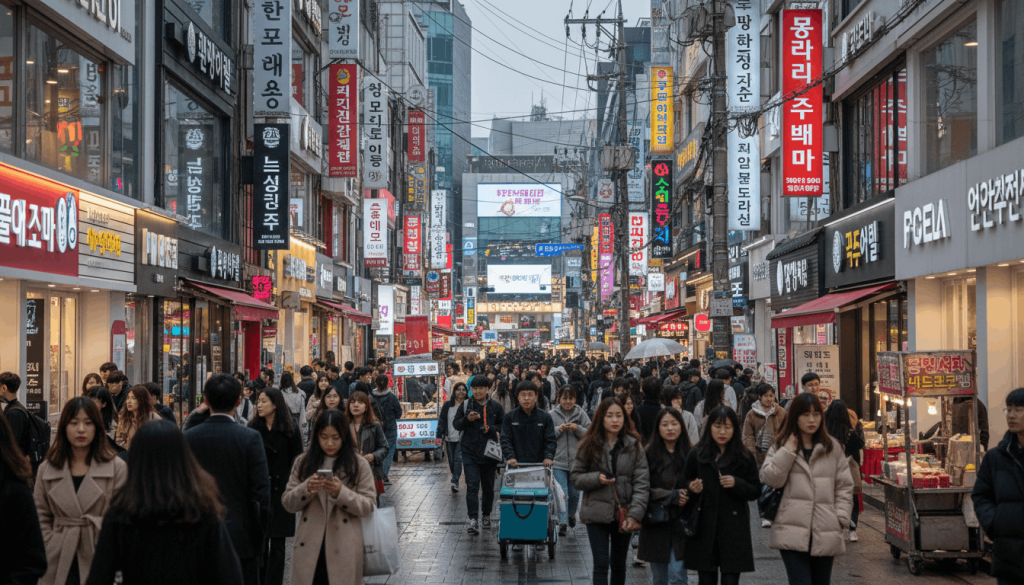
Myeongdong is roughly one square kilometre of pedestrian shopping streets in central Seoul: Korea’s highest-density retail zone by almost any measure. It is simultaneously the best place in the country to find K-beauty at flagship prices, and the place where an unprepared tourist most reliably gets overcharged, pushed into signing up for memberships, or confused about what “duty free” actually means.
This guide is structured around two variables: how much time you have, and how much you plan to spend. If you’re arriving for a four-hour layover, you need a different map than someone doing a two-day beauty haul. I’ve run all of these scenarios myself.
TL;DR: Four hours? Exits 6–7, main street, Olive Young Central (3F for skincare, 2F for makeup), one meal. Full day? Add the side alleys, tax refund paperwork, and a department store. Two days? Add Shinsegae’s food basement, the wholesale cosmetics area near Hoehyeon Station, and the evening street food circuit.
→ Planning a beauty haul? Our Olive Young Shopping Guide breaks down every floor of the Central Myeongdong flagship that opened in March 2026, with a budget calculator for first-timers.
Myeongdong: Layout and How to Read the Area
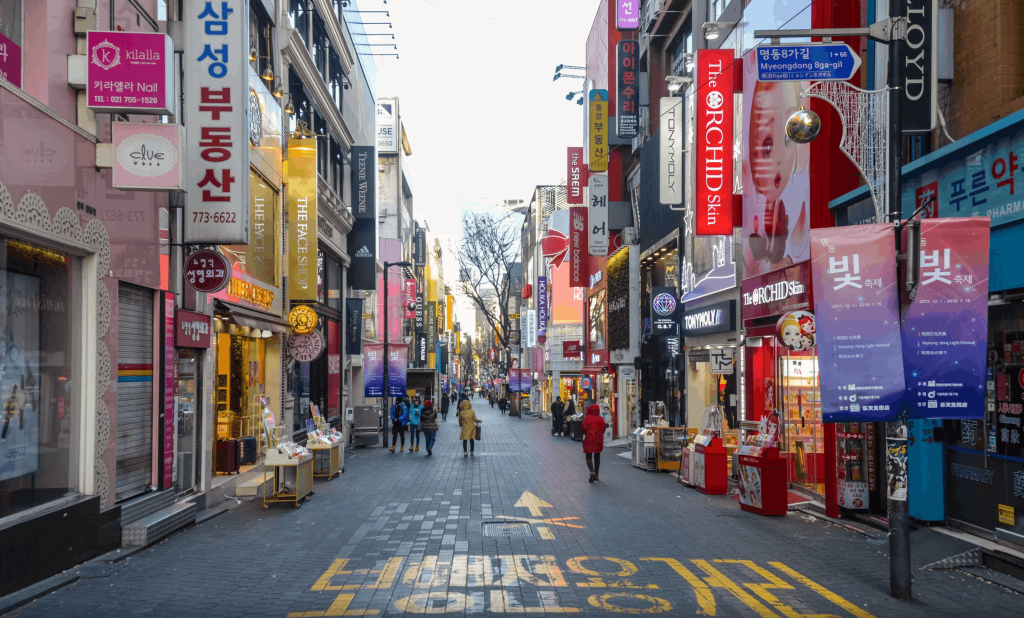
The district runs roughly 400 metres between two subway stations: Myeongdong Station (Line 4, exits 5–8) in the south and Euljiro 1-ga Station (Line 2, exit 5) in the north. The main shopping artery connects them. Everything else is side alleys that branch off left and right.
The main street (명동길) is where the flagship cosmetics brands, international fashion labels, and highest footfall concentrate. If you have one hour, this is where you spend it. The street is pedestrian-only and car-free. K-beauty chains line both sides — Innisfree, Nature Republic, Etude, The Face Shop — though the standalone brand stores have thinned out over the past few years as Olive Young has consolidated much of the cosmetics market under one roof.
The side alleys branch east and west from the main drag. These are where you find independent fashion, character goods stores, smaller cosmetics operations, and the street food stalls that set up from around 17:00. The western alleys (toward Lotte) run denser and more commercial; the eastern alleys (toward Myeongdong Cathedral) are slightly quieter.
The department stores sit at the northern end. Lotte Department Store Main Branch and Lotte Young Plaza are adjacent and functionally connected. Shinsegae is a five-minute walk southwest along Toegyero. Both open at 10:30 and close at 20:00 (Mon–Thu) or 20:30 (Fri–Sun) — data confirmed May 2026.
Subway exit recommendations by intent:
- Exit 5 or 6 (Line 4): Best for the main cosmetics strip, drops you at the southern entry of the main street
- Exit 7 or 8 (Line 4): Better for the side alleys and evening street food area
- Exit 5 (Line 2, Euljiro 1-ga): Best for the northern end, Lotte Department Store access
My take: Use exit 6 for a first visit and work north. On return visits I use exit 8, which puts me directly into the side alleys where the independent stores are.
Myeongdong by Time Available
The 4-Hour Layover Plan
This assumes you’ve come straight from your hotel or the airport with a specific list. No wandering — you’re optimising.
Recommended exit: Line 4, Exit 6. Walk north on the main street.
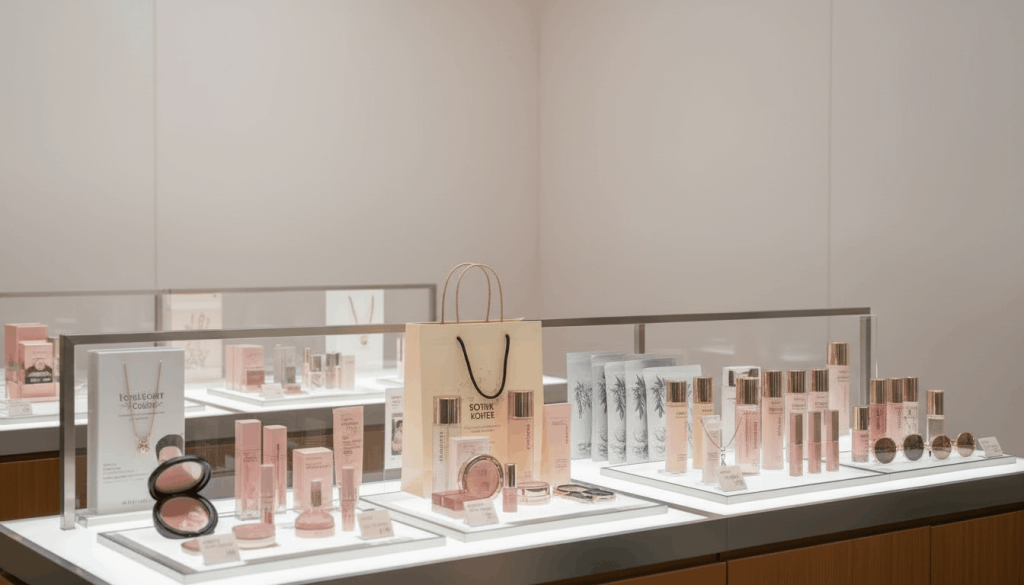
Stop 1 (45 min): Olive Young Central Myeongdong (53 Myeongdong-gil) — the flagship that opened March 26, 2026. It’s the largest Olive Young in Myeongdong and the second largest in Korea after the Seongsu flagship, carrying ~15,000 products from ~1,000 brands. Layout: ground floor for general K-beauty and entry picks; second floor for makeup; third floor for skincare and wellness. Take a list, go straight to the right floor, and avoid the “sample at the door” pressure from staff. Prices here are standard nationwide — you’re not paying a tourist premium on the products themselves.
Stop 2 (30 min): One or two standalone brand stores if you have specific label loyalties. Innisfree and Nature Republic are both on the main street with English-speaking staff. For anything involving a new skincare routine, these stores will do patch tests and consultations if you ask.
Stop 3 (30 min): Tax refund paperwork. Ask for the refund form at every store where you spend ₩15,000 (~$10 / €9) or more. Don’t leave this until the airport — it takes longer there and the kiosk queues are unpredictable. More on the process in the tax refund section below.
Meal (45 min): The Shinsegae food basement on Toegyero is a 5-minute walk. Full proper Korean meals, no tourist markup, no language barrier with picture menus. The Lotte food hall in B1 is closer but more expensive.
Buffer + shopping (remaining time): Walk back via the alleys for any impulse additions.
The Half-Day Plan (4–6 hours)
Everything in the layover plan plus the side alleys east of the main street, where you’ll find: character goods stores (Kakao Friends, Line Friends, Sanrio collaborations), independent fashion with prices lower than the main strip, and the start of the evening street food setup if you extend into the 17:00 hour.
Add Lotte Young Plaza (B1 and 1F for cosmetics, 1F for international fashion brands, 6F for Uniqlo) if you want to compare department store pricing to street pricing for the same products — which sometimes favours the department store when their app coupons apply.
Editor’s tip: Download the Lotte app and create an account before you arrive. First-time members frequently receive 20–30% off coupons that can be applied to cosmetics purchases. This takes five minutes at the hotel before you leave and can save a meaningful amount on a larger haul.
The Full Day Plan (8–10 hours)
Open with the department stores at 10:30 before the crowds arrive. Lotte’s cosmetics floors in the morning are genuinely navigable — by afternoon they’re shoulder-to-shoulder with tour groups. Use the morning for considered purchases; use the afternoon for the street scene.
Morning (10:30–13:00): Lotte Main Branch. Go directly to the cosmetics floor (usually B1 or 1F depending on the brand category). The tax refund desk here processes forms for all Lotte purchases — you can consolidate receipts at a single counter rather than queueing at each individual brand.
Lunch (13:00–14:00): Shinsegae food basement. The Korean food court here — proper gukbap, kalguksu, bibimbap — costs roughly ₩10,000–₩15,000 (~$7–$10 / €6–€9) per person and is consistently good. Avoid the tourist-facing restaurants on the main street for sit-down meals; the price-to-quality ratio is poor.
Afternoon (14:00–17:00): Main street and side alleys. By now you know what you want and can focus. The cosmetics-only side street that runs parallel to the main drag (often called “Cosmetics Row” by visitors) has Innisfree, Etude, Nature Republic, and The Face Shop within 200 metres of each other — useful for direct comparison before committing.
Evening (17:00–20:00+): Street food circuit and the second wind of shopping. Stalls appear from around 17:00 and the area feels completely different after dark — louder, more chaotic, better lit by neon. This is the time for street food and browsing without buying pressure.
The 2-Day Plan
Day 1 follows the full-day plan above. Day 2 shifts to a different mode: the wholesale cosmetics area near Hoehyeon Station (exit 4, between the back of Lotte Avenuel and Namdaemun), where smaller cash-only shops sell near-wholesale prices to anyone willing to buy in quantity; Shinsegae as a full destination rather than just a lunch stop; and the cathedral courtyard, which most visitors skip entirely.
My take: Two days works if you’re doing a serious haul with methodical brand comparison. The street scene is identical on Day 2 — what changes is depth. If you need novelty, Day 2 is better spent in Hongdae or Dongdaemun.
→ Heading to Dongdaemun after Myeongdong? Our Dongdaemun Shopping Guide covers the wholesale clothing market, the night hours, and the differences from Myeongdong’s retail model.
Myeongdong by Budget
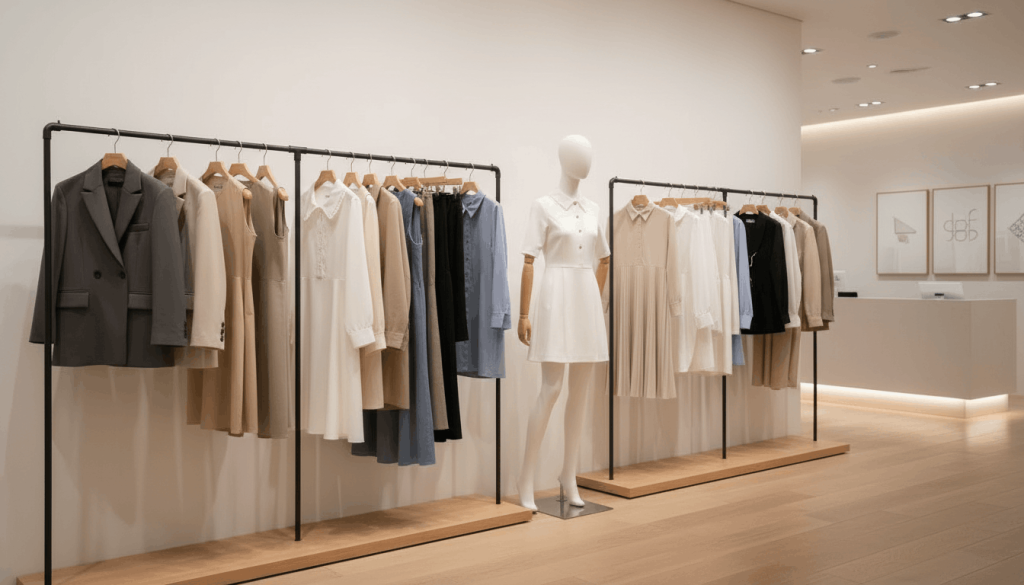
$50 / ₩75,000 (~€45) — The Souvenir Run
At this budget, Myeongdong makes sense as a one-stop souvenir operation. Sheet masks (₩1,000–₩3,000 / ~$0.65–$2.00 / €0.60–€1.70 each at Olive Young), character keychain goods, and small cosmetics gift sets all fall comfortably within this range. A realistic haul:
- 10–15 sheet masks from Olive Young: ₩15,000–₩25,000 (~$10–$17 / €9–€14)
- 2–3 lip tints or small skincare items: ₩20,000–₩30,000 (~$13–$20 / €11–€17)
- Street food for lunch and a snack: ₩8,000–₩12,000 (~$5–$8 / €5–€7)
Tax refund eligibility starts at ₩15,000 per store. At this budget you’ll likely hit the threshold at one or two stores. The refund (roughly 5–8% after processing fees) will be small — probably ₩1,500–₩3,000 (~$1–$2 / €0.85–€1.70) — but worth filing the paperwork if the receipt is in hand.
$150 / ₩225,000 (~€135) — The Cosmetics-First Run
This is where the trip starts to make financial sense relative to buying the same products at home. A realistic simulation (prices as of May 2026):
- Toner + essence + moisturiser set (mid-range brand like COSRX, Some By Mi, or Dr. Jart): ₩45,000–₩70,000 (~$30–$47 / €26–€40)
- 2–3 targeted treatment products (serums, sunscreen, exfoliant): ₩35,000–₩55,000 (~$23–$37 / €20–€31)
- 5 sheet masks: ₩5,000–₩10,000 (~$3–$7 / €3–€6)
- Street food and one sit-down meal: ₩15,000–₩20,000 (~$10–$13 / €9–€11)
- Tax refund on qualifying purchases: ₩3,000–₩8,000 (~$2–$5 / €1.70–€4.55) returned
Total time on site: 3–4 hours at a focused pace.
$300 / ₩450,000 (~€270) — Cosmetics + Clothing + Gifts
At this level, the department stores become relevant. Lotte carries Korean fashion brands (Maje, System, Sjyp) that are priced noticeably lower than their equivalent in Western markets. A realistic split:
- Cosmetics haul (as above, scaled up): ₩120,000–₩150,000 (~$80–$100 / €68–€86)
- One mid-range clothing item (Lotte Young Plaza or Musinsa Myeongdong): ₩60,000–₩100,000 (~$40–$67 / €34–€57)
- Gift goods and character merchandise: ₩40,000–₩60,000 (~$27–$40 / €23–€34)
- Food and transport: ₩20,000–₩30,000 (~$13–$20 / €11–€17)
- Tax refund on qualifying purchases: ₩8,000–₩18,000 (~$5–$12 / €4.55–€10.30) returned
Budget this as a full-day itinerary, not a half-day sprint.
$500+ / ₩750,000+ (~€430+) — The Full Haul
At this level, the tax refund becomes real money — 5–8% on ₩750,000 is ₩37,500–₩60,000 (~$25–$40 / €21–€34). The Lotte Duty Free (floors 7–12 of the Lotte building — a separate operation from the department store below) is relevant for premium cosmetics, electronics, and luxury goods at prices that include no Korean VAT. Important: duty-free purchases are not handed to you at the store. They are held and collected at a dedicated counter at Incheon Airport after customs clearance, just before boarding. Budget a full day and handle all tax refund paperwork as you go rather than in one airport scramble. For purchases over ₩1,000,000 (~$667 / €571), customs inspection at Incheon is typically required — pack those items in carry-on, not checked luggage.
Top Streets & Stores
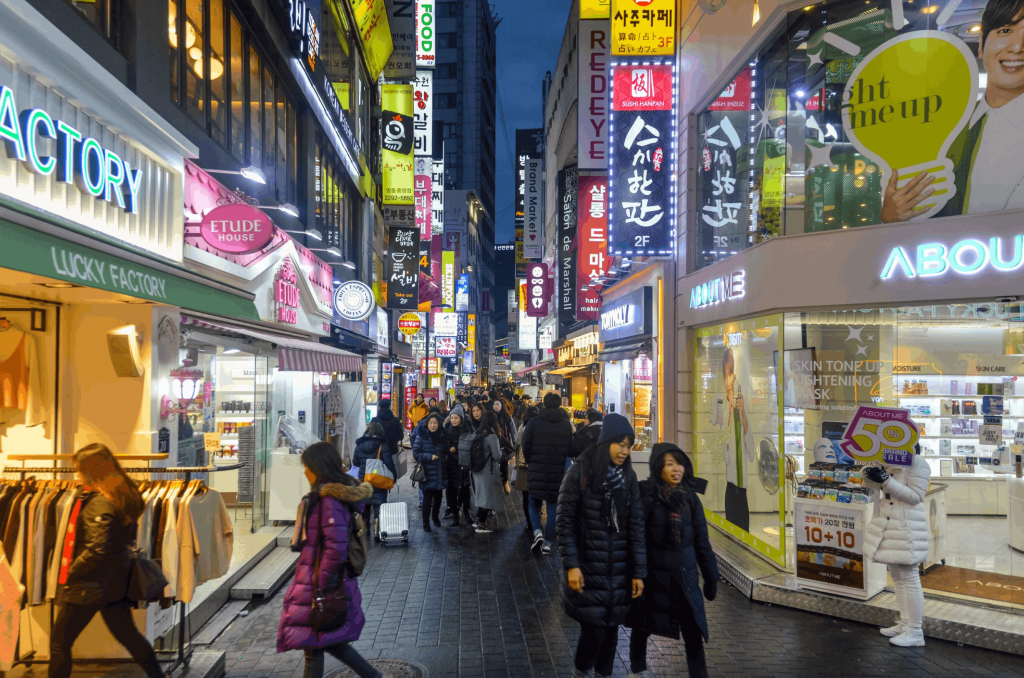
Main Street (명동길): The core artery. High foot traffic, high signage density, every major cosmetics chain represented. Olive Young Central Myeongdong opened March 2026 and is now the anchor — three floors, the widest in-district inventory, with skincare concentrated on the third floor and makeup on the second. Musinsa now has two distinct operations in the district: Musinsa Store Myeongdong (opened January 30, 2026), a multi-brand K-fashion shop with 110+ labels spread across B1 to 3F; and Musinsa Standard Myeongdong (opened March 2024), the brand’s own casualwear line. A third location — Musinsa Standard Myeongdong Central, ~1,650 m² — is scheduled to open in September 2026.
Cosmetics Row (side alley, east of main street): Not an official name — it’s the alley where standalone brand stores have concentrated as they’ve been displaced from the prime main-street rents. Innisfree, Nature Republic, Etude, The Face Shop. Useful for brand-specific testing and consultation before buying. Also worth noting: OFF BEAUTY, Korea’s first discount cosmetics outlet and a cheaper alternative to Olive Young, has been expanding in Myeongdong through 2026 — worth checking for discounted stock if you’re budget-conscious.
Lotte Department Store Main Branch: Open 10:30–20:00 (Mon–Thu), 10:30–20:30 (Fri–Sun). The cosmetics floor (B1) is the most efficient place in Myeongdong for consolidated brand comparison. The in-house tax refund desk handles all Lotte receipts. Luxury brands (Gucci, Chanel, Louis Vuitton) are on 1F.
Lotte Young Plaza: Adjacent to the main store. Better for Korean contemporary fashion (B1 and 1F), shoes (3F), and Uniqlo (6F) than for cosmetics. Also houses the Lotte Cinema on the upper floors.
Shinsegae Department Store: Five-minute walk from the main street on Toegyero. Open 10:30–20:00 (Sun–Thu), 10:30–20:30 (Fri–Sat). More expensive average price point than Lotte, quieter atmosphere, better food basement. The cosmetics selection tends toward Western luxury brands rather than K-beauty.
→ Going deep on K-beauty? Our Korean Skincare Buying Guide covers ingredient priorities, how to identify your skin type using Korean dermatology standards, and what to actually buy versus what’s marketing.
Tax Refund Counters in Myeongdong
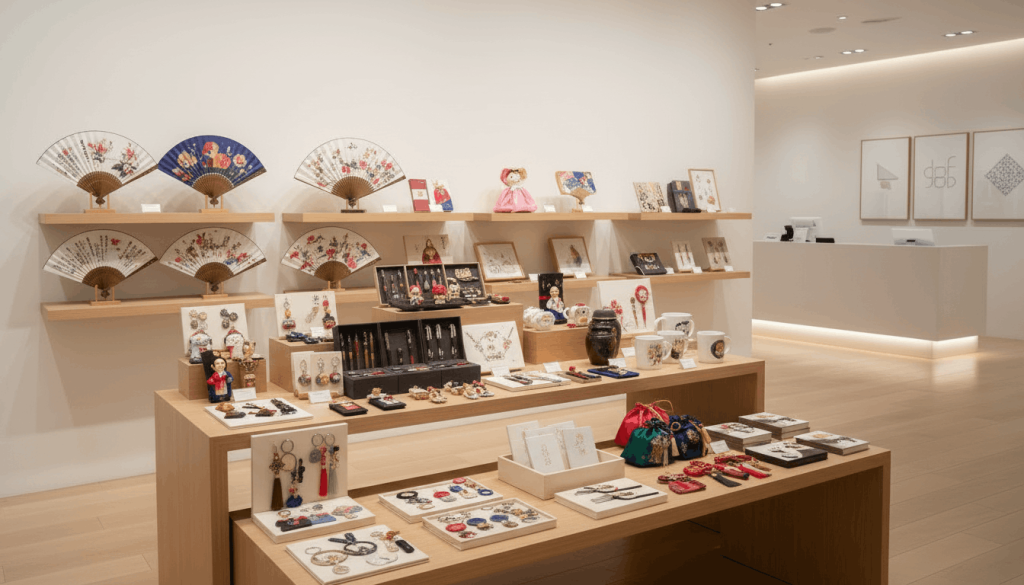
Korea’s VAT (부가가치세) is 10%. As a foreign tourist, you’re entitled to claim back roughly 5–8% on purchases of ₩15,000 (~$10 / €9) or more per store after processing fees are deducted, though some stores set their minimum at ₩30,000 (~$20 / €17), so confirm at the register before paying. This is not automatic — you have to ask for the tax refund form at checkout, present your passport, and follow through at either a downtown counter or at Incheon Airport.
Downtown refund (recommended for larger hauls): The most efficient approach if you’re spending at multiple stores and don’t want to spend 45 minutes in a queue at the airport. Downtown refund counters exist in and around the Myeongdong area — Global Blue and Global Tax Free both operate kiosks and staffed counters near the tourist centre and inside the Lotte complex. Present your receipts and passport, collect cash refund on eligible forms. Important: even if you collect cash downtown, you must still scan your receipts at the Incheon Airport kiosk before departure. If you skip this step, the downtown refund amount will be charged back to your card with a penalty.
Airport refund: The fallback option for receipts that weren’t processed downtown, or for purchases where the store offers airport-only refunds. Kiosks at Incheon T1 are near Gate 28 (3F, duty-free zone); T2 kiosks are near Gates 249–253. Kiosks operate 24 hours. Staffed counters at T1 are open 07:00–22:00; T2 counters open 07:00–21:00. Allow at least 30 minutes for this process, more during peak seasons.
Global Blue vs Easy Tax Free vs KTP: These are the three dominant operators. The operator assigned to your receipt depends on the store’s contract, you don’t choose. In practice, the 2026 Incheon kiosks are integrated and will process receipts from any operator at the same machine. If you need a cash payout at the desk rather than a card credit, you may encounter separate lines for different operators.
My take: On a $300 day, the tax refund on qualifying purchases is typically ₩10,000–₩18,000 (~$7–$12 / €6–€10). That covers dinner. It’s worth the fifteen minutes of paperwork.
→ Full step-by-step process with common mistakes: Our Korean Tax Refund Guide covers the complete airport process, the common mistakes that invalidate refunds, and how to handle high-value item inspection.
Street Food While Shopping
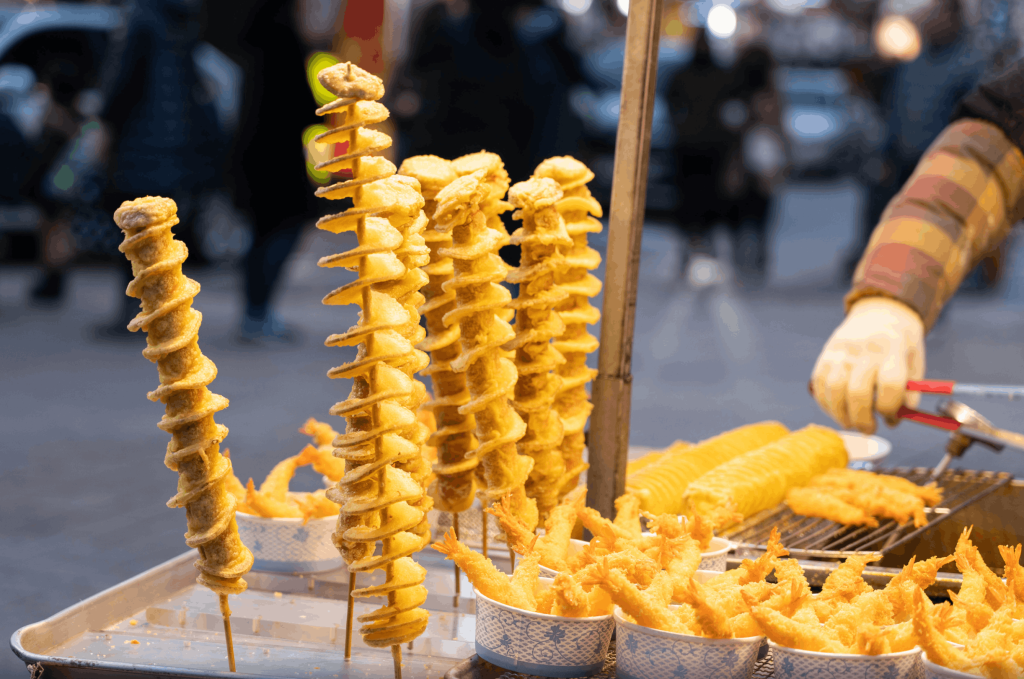
Street food in Myeongdong is consistently 30–50% more expensive than in neighbourhood markets elsewhere in Seoul. That said, the quality-to-convenience ratio holds up, and the variety in a concentrated area is difficult to match. Stalls start appearing from around 17:00; by 19:00 the main alleys are fully operational. Bring ₩20,000–₩30,000 (~$13–$20 / €11–€17) in cash — most stalls are cash-only.
Five worth trying (prices as of May 2026):
- Tteokbokki (떡볶이): Spicy rice cakes in gochujang broth, ₩4,000–₩5,000 (~$2.65–$3.35 / €2.30–€2.85) per cup. The Myeongdong versions tend to add cheese skewers as an option. Classic, filling, correctly spicy.
- Gyeran-ppang (계란빵): Egg bread — a hot, oval-shaped bread baked around a whole egg, ₩1,500–₩2,000 (~$1.00–$1.35 / €0.85–€1.15). The most underrated item on the street. Good as a fast, warm snack that won’t interfere with dinner.
- Tornado potato (회오리감자): A spiralled potato fried on a skewer, ₩3,000–₩4,000 (~$2.00–$2.65 / €1.70–€2.30), available with cheese dust, spicy seasoning, or plain. The kind of thing that photographs well and tastes exactly as it should.
- Korean corn dog (핫도그): Mozzarella or sausage (or both), wrapped in rice flour batter, often with a fry-chip or ramen-noodle coating, ₩4,000–₩6,000 (~$2.65–$4.00 / €2.30–€3.45). The texture is distinctive from Western corn dogs — chewier, with a satisfying pull on the cheese interior.
- Grilled lobster tail (랍스터꼬리): This stall category appeared around 2024 and has become one of Myeongdong’s most-photographed items — a split lobster tail grilled with butter and seasoning, ₩15,000–₩20,000 (~$10–$13 / €9–€11). Expensive relative to the portion, genuinely good if you find a stall that’s turning over stock fast. The ones with long queues at 18:00 are the ones to trust.
Hygiene indicator: Watch turnover speed. In a tourist food street, long queues are usually a positive signal — high turnover means fresh ingredients and fewer items sitting under heat lamps for hours. A stall with three customers who’ve been waiting and another three already eating is better than a quiet stall with items that look like they’ve been sitting.
→ Seoul street food beyond Myeongdong: Our Korean Food Guide covers Gwangjang Market, Tongin Market’s dosirak café, and the differences between tourist-zone and neighbourhood street food.
Avoiding Tourist Traps
Myeongdong has a few recurring traps that cost tourists money in ways that are hard to identify in the moment.
Aggressive sampling and purchase pressure: Staff outside cosmetics stores — particularly smaller independent operations rather than the major chains — will offer free samples and begin applying products to your face or hands without asking. Once this starts, the social pressure to purchase is deliberately high. You are under no obligation to buy anything because someone applied a product to your skin. “No thank you” in Korean (괜찮아요, gwaen-chan-a-yo) works; so does walking. Don’t stand still near these stalls unless you’re genuinely interested in what they’re selling.
Duty-free vs tax refund confusion: These are different things. Duty-free refers to specific shops (Lotte Duty Free on floors 7–12 of the Lotte building, SM Duty Free) where prices exclude taxes from the point of sale. Crucially, you do not leave the store carrying duty-free purchases — they are held and collected at a dedicated counter at Incheon Airport before you board, after customs clearance. You’ll need to show your boarding pass when purchasing. Tax refund, by contrast, is a post-purchase reimbursement on regular retail buys that you do take with you on the day. Some shops use “tax free” in their signage in ways that imply both systems, when they’re only participating in one. Ask specifically which applies before making large purchases.
Currency exchange at the airport or hotel: If you’re exchanging cash, the airport counters and hotel desks offer the worst rates in the city. Myeongdong has several licensed exchange booths on the side alleys and near the tourist information centre. Rates here are significantly better than hotel rates and comparable to bank rates. For even better rates, the money changers in Namdaemun Market (a five-minute walk) are the benchmark in central Seoul.
Counterfeit and grey-market goods: Cosmetics in street stalls rather than inside branded stores should be treated with caution. The major chain stores (Olive Young, the brand flagships, the department stores) carry authentic products. Street vendors selling cosmetics from open cases are not guaranteed to carry authentic stock. For skincare specifically, counterfeit products in this market have included unverified ingredients — not a theoretical risk.
“Best price” negotiation: Prices in chain cosmetics stores, Olive Young, and the department stores are fixed — negotiation is not appropriate and will make the staff uncomfortable. The only places in Myeongdong where prices are genuinely negotiable are the smaller independent vendors and parts of the wholesale zone behind Lotte, particularly for multi-piece purchases.
Getting to Myeongdong
From Gangnam: Line 2 to Euljiro 1-ga (30 min), exit 5. Or Line 9 to Sinnonhyeon, transfer to Line 2 (35 min total).
From Hongdae: Line 2 to Euljiro 1-ga (25 min), exit 5.
From Itaewon: Line 6 to Samgakji, transfer to Line 4 to Myeongdong (20 min), exits 5–8.
From Haeundae (Busan): KTX to Seoul Station (2 hrs 15 min), then Line 4 north two stops to Myeongdong.
A T-money card covers all of these routes — load ₩20,000 (~$13 / €11) before you leave the hotel and it’s enough for a full day of transit in and around Myeongdong. Transfers between Line 2 and Line 4 within 30 minutes are discounted automatically.
→ T-money card setup and reloading: Our T-money Card Guide covers the new international card kiosks on Seoul Metro Lines 1–8, the MobileTmoney Apple Wallet integration launched in April 2026, and the refund process before you leave Korea.
Author’s Personal Top 5
After thirty-plus visits, these are the places I actually return to rather than the ones I recommend because they’re on every other list.
1. Olive Young Central Myeongdong (53 Myeongdong-gil, opened March 2026) The new flagship is the best single K-beauty retail space in the district and the second largest Olive Young in Korea. Three floors: ground for general picks and impulse buys, second for makeup, third for skincare and wellness — the one you came for. A testing area on the ground floor lets staff match products to your skin type without pressure. Get there at opening.
2. The wholesale cosmetics alley near Hoehyeon Not signposted for tourists and not in English. The area to look for runs between the back of Lotte Avenuel and the streets toward Namdaemun Market — easiest to reach from Hoehyeon Station (Line 1, exit 4) rather than from the Myeongdong main street. Smaller cash-only shops here sell cosmetics at near-wholesale prices, consistently 20–40% cheaper on multi-piece purchases than the retail stores. You need to know what you want before you go in — staff don’t give consultations here, they sell volume.
3. Shinsegae B1 food floor for lunch Not shopping, but consistently the best sit-down meal option in the district that doesn’t require waiting 40 minutes or paying tourist-menu prices. The kalguksu (knife-cut noodle soup) stall at the back of the food basement has been there for years and deserves to be there for years more.
4. The ganjang gejang rice roll stall, evening hours Near the Lotte Young Plaza exit on the eastern side, a vendor in her late 60s operates from around 17:00 selling ganjang gejang (raw marinated crab) pressed into seaweed rice rolls. She typically sells out by 20:30. The only tourist this stall gets are the ones who wander without a plan and follow their instincts. Worth every won.
5. Myeongdong Cathedral at any time Five minutes from the main shopping street and almost completely ignored by the shopping crowds. Built in 1898, Seoul’s oldest Gothic church. It’s not a shopping stop, obviously — but taking ten minutes away from the commercial noise to sit in the courtyard resets the experience entirely. I visit every time I’m in Myeongdong.
FAQ
What can I buy in Myeongdong? Korean skincare and cosmetics are the core draw — toners, essences, serums, sunscreens, and sheet masks from both chain pharmacies and standalone brand stores. Beyond K-beauty: Korean contemporary fashion, character merchandise, international brand flagships, and street food. Less useful for electronics (better in Yongsan) or luxury goods at the best prices.
Is Myeongdong cheap? For cosmetics, prices are standard to the Korean national retail price — identical to any Olive Young in the country. Street food is 30–50% more expensive than in neighbourhood markets. Sit-down restaurants on the main strip are overpriced. Department store food floors are fair value. The real savings are on K-beauty products compared to buying them outside Korea.
What’s the best time to shop Myeongdong? Weekday mornings (10:30–13:00) for the department stores, when crowds are lowest and staff have time for proper consultations. Evenings (17:00–20:00) for street food and the full atmosphere. Avoid Saturday afternoons and Sunday if you have any flexibility — peak congestion.
Myeongdong vs Dongdaemun — which is better? Different purposes. Myeongdong is retail cosmetics, fashion flagships, and tourism-facing street food. Dongdaemun is wholesale fashion and late-night shopping (many stores open at midnight). For cosmetics, Myeongdong wins. For fashion in bulk at near-wholesale prices, Dongdaemun is the right choice.
How does the tax refund work in Myeongdong? Ask for a “tax refund form” at checkout at any participating store when you spend ₩15,000 (~$10 / €9) or more — you need your passport. Some stores set their minimum at ₩30,000 (~$20 / €17), so confirm before paying. Process the form at a downtown counter near the Myeongdong tourist centre or inside Lotte, or at Incheon Airport. If you collect cash downtown, you must still scan receipts at the airport kiosk before departure or the amount gets charged back with a penalty.
Is Myeongdong safe? Yes. The more relevant concern is pressure tactics from independent cosmetics vendors — which are legal but occasionally aggressive. Walk away; you’re under no obligation to buy anything because someone applied a sample to your skin.
How long should I plan for a Myeongdong visit? Minimum 3 hours for a focused cosmetics run. 5–6 hours for a comfortable day including lunch and tax refund paperwork. Two days only makes sense for a serious multi-store haul with comparative shopping.
Are there ATMs in Myeongdong? Yes. Multiple Korean bank ATMs accept international cards throughout the area. For the best exchange rates, use the licensed exchange booths on the side alleys rather than ATMs if you’re dealing in cash.
What should I do if my foreign credit card is rejected? Major chains (Olive Young, brand flagships, department stores) accept international Visa, Mastercard, and UnionPay reliably. For street vendors and the wholesale zone, carry Korean won cash. WOWPASS or NAMANE cards function as local debit cards and eliminate this issue.
Can I find non-cosmetics gifts in Myeongdong? Yes — character goods (Kakao Friends, Sanrio), Korean snack and confectionery packs, K-pop merchandise, and some traditional craft items near the cathedral end. Narrower range than Insadong for traditional crafts, but the convenience factor is high for souvenir-scale gift buying.
The Bottom Line
Myeongdong rewards preparation and punishes wandering. Know your skin type before you arrive. Download the Lotte app the night before. Bring cash for street food. Ask for the tax refund form at every qualifying purchase without exception. And if a staff member starts applying something to your face before you’ve agreed to anything, it’s fine to just walk.
The district itself is genuinely worth the visit — there’s nowhere else in Korea where this density of K-beauty, food, and street energy coexists in a single walkable hour. But the experience is measurably better with a plan than without one.
Next reads:
- Olive Young Shopping Guide — the complete floor-by-floor breakdown of the March 2026 flagship
- Korean Tax Refund Guide — step-by-step with the most common mistakes that invalidate refunds